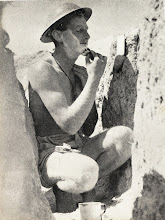
The Entry from the inside.
Waiting in the cave for the shelling to stop.
images 021023, 021021 and 021026 Australian War Memorial.
The 2nd A.I.F's 9th Australian Division of WW2.
The Entry from the inside.
Waiting in the cave for the shelling to stop.
images 021023, 021021 and 021026 Australian War Memorial.
2/15th Infantry Battalion
2/17th Infantry Battalion
New South Wales.
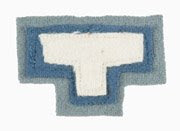
These are the felt colour patches worn by the members of the 20th Brigade of the 9th Australian Division. The felt colour patch is worn on the upper outer sleeve of the tunic on both the left and right arms. They differ from other patches that were worn by other members of the AIF in the Second World War in that they are shaped like the letter 'T' whereas members of the 6th, 7th (except the 18th Brigade) and 8th Divisions wore a patch in the shape of a diamond separated into a top half colour and a bottom half colour.
The significance of the colour patches as worn by the 9th Division and members of the 18th Brigade of the 7th Division is that the shape has been varied from the AIF standard diamond to that of the letter 'T' in tribute to the Battalion's involvement in the defence of Tobruk. It was a badge that the Rat's wore with pride. When on leave everyone knew they were the one's who stopped Rommel in his tracks for so long.
The grey outline signifies the 9th Australian Division, the green border belongs to the 20th Brigade and the 'T' shape is in the individual battalion colours, the 2/13th was black, the 2/15th was purple and the 2/17th was white.
The changing of the colour patch's shapes, in recognition of the men involved in the Siege of Tobruk, has only ever been done this once in the entire history of the AIF.
This is one of the best indications of the significance of the action that the 9th Division was involved in at Tobruk was not lost on the Army. The Army changed nothing in recognition of deeds performed during World War One. This to me is one of the highest honours that the Army ever placed on the 9th Division.
colour patch images General Collection Australian War Memorial.


The Italian Breda Model 35 20mm Anti-Aircraft Gun.
Men of 4 Section, D Coy. have a bit of fun on a captured Italian Breda Model 35 20mm cannon. These flak guns were primarily used in an anti-aircraft capacity however they had some use against soft targets like trucks, cars and infantry.
This photo was taken at Alamein in 1942 by my Grandfather, NX17811 Pvt. L.J. McCarthy of the 2/17th Infantry Battalion. This particular gun was popular amongst troops of the 2/17th for posing on for photos to send home. I have seen a photo of Jack Barber, also of the 2/17th and author of "The War, The Whores and the Afrika Korps", trying out the same gun in the photos within his book.
Click on the image for a high resolution copy.
image from the author's personal collection.


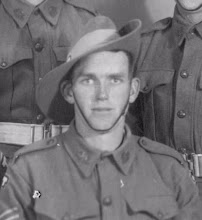
NX21849 Pvt. Elson Evered Bell on leave, aged 18 years.
If you are thinking that Pvt. Bell of the 2/17th Infantry Battalion looks young, that's because he was. Following in the time honoured Australian tradition of not being entirely truthful about your age to go to war Pvt. Bell bumped up his age by 5 years to meet the strict age requirements of the Second A.I.F.
Being only 16 years, 7 months old when he enlisted on 27th May 1940 (the day before my Grandfather) Pvt. Bell was the youngest man Mentioned in Despatches (MiD) at Tobruk.
The Australian War Memorial writes "Private K E Bell, A Company, 2/17th Infantry Battalion ... was aged 17 years when he was Mentioned in Despatches for bravery at Tobruk. During an offensive patrol he carried in his officer although wounded himself. The officer later died."
The Australian War Memorial credits this photo as being of Pvt. K. E. Bell of the 2/17th Battallion. My personal research has led me to believe that the baby faced Rat of Tobruk was actually Pvt. E. E. Bell who was, like the AWM states, a member of A Coy. 2/17th Battalion who was Mentioned in Despatches and wounded in Tobruk.
The nominal roll of the 2/17th Battalion shows only one soldier with a surname of Bell who was wounded at Tobruk, and no soldier with a name of K.E. Bell. The nominal roll of the 2/17th lists his service number as NX21849 and also mentioned was the fact that he was wounded not only at Tobruk, but also Alamein and New Guinea. He was discharged on 30th November, 1945 having just celebrated his actual 21st birthday the month before. How bizarre to think that Pvt. Bell fought a World War for 5 years and won all before his 21st birthday.
They don't make 'em like him anymore.
image 024225 Australian War Memorial
Nominal roll research from "What we have, we hold - A history of the 2/17th Australian Infantry Battalion", 2/17th Battalion History Committee, Sydney.
At the time of the following incident, Henry was a corporal of 18 Platoon, D Company 2/17th Battalion. He wrote of a remarkable feat by one soldier on the second night of the Battle of El Alamein as follows;image composite of crop from 020286 Australian War Memorial and photo of Henry Zouch from my personal collection.
The anecdote is taken from one submitted by Henry Zouch to "What we have, we hold - a history of the 2/17th Australian Infantry Battalion 1940-1945" by the 2/17th Battalion History Committee. Published under fair dealing for review as allowed by the Copyright Act.
NX60436 Sgt. Henry Eddington Zouch passed away in 1999.
He was 79 years old.
This photo was taken at Anzac Day at Sydney in the early to mid 1990's. I was stunned to find that a photo from my personal collection featured the same men as Lt. Fisher's photo. The two men on the outsides are currently unidentified but the others are exactly as posed in the original photo. My Grandfather is second from the right.
The beauty of this photo is in the fact that all 5 men survived the war, however not all of them unscathed. Of the three identified members only Henry Zouch was not reported wounded in action (W.I.A.). Both Charlie Lemaire and Les McCarthy were wounded at Alamein and Les McCarthy was further wounded in New Guinea in 1943 when a Private accidentally discharged his Bren Gun shooting my Grandad twice, once in the right thigh, the other in the right shin. This was a wound that took months to heal. The funny thing is that when the incident was originally reported to Senior Officers my Grandfather, a section Corporal, covered for the Private under his command and reported the wounds as having been received from a strafing Japanese Zero fighter plane. It wasn't until many months later with the potential for an army board of enquiry looming that the official record was amended to reflect that the wounds were received by "accidental discharge of section's Bren Gun". Amazing what information is in official service records.
To view the original post and photo about Tobruk's Bush Artillery click here http://9thdivvy.blogspot.com/2008/07/image-tobruks-bush-artillery.html
27th August, 1941.