Showing posts with label [Rommel]. Show all posts

Saturday, September 13, 2008

[Image] United we Stand!

22nd October, 1941. Tobruk, Libya.

The Men of Five Nations.

During the Siege of Tobruk the Men of 5 Nations were all that stood between Rommel and the Middle Eastern oil fields. Holding out at Tobruk, under siege by the German Afrika Korps and the Italian Army, these men made the German High Command commit far more troops and supplies to the maintenance of the siege than they were comfortable with, far weakening the Axis thrust into Egypt. It also denied Rommel the means of transporting the immense amount of supplies needed to wage a desert war via ship.

Everything the Axis used had to be transported by land across the desert from Tripoli, over a 1,000 miles away. Holding out for the 8 months that they did allowed the Allies to conclude negotiations with the United States for the supply of war materials that would ultimately arrive in time for the Battle of El Alamein in October, 1942.

The men that held the Axis at Tobruk, the only men entitled to be called 'Rats of Tobruk' came from (from left to right) Poland, Britain, India, Australia and Czechoslovakia.

Whilst this blogs primary focus is on the Australian 9th Division's contribution to the war effort the author acknowledges the sacrifice made by the men of all of these nations and I will endeavour to feature them when I have suitable material and a bit more time.

images 041852 and 041853 Australian War Memorial.


Thursday, August 21, 2008

[Quote] Lt Gen Erwin Rommel

1941. North Africa.

Lt General Erwin Rommel
GOC Deutsches Afrika Korps

Rommel, never one to hold back with his thoughts, when asked his opinion on the Australian 9th Division opposing him in Tobruk had this to say;

“The toughest but least disciplined troops in North Africa".

image p01112.001 Australian War Memorial.

Sunday, August 17, 2008

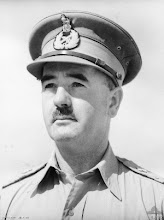
[Image] Rommel in Colour

1941, Western Desert, Libya.

Lt. Gen. Erwin Rommel.
GOC Deutsches Afrika Korp.

This rare photo of Rommel in colour in the Western Desert gives a great insight into the German high command of the Afrika Korp. The formality of the uniforms is astounding considering the heat experienced in the desert. Even Morshead wore shorts.

An interesting anecdote I have come across worth sharing is one about Rommel's goggles. It was written that Rommel found these goggles in the wreckage of an Australian armoured vehicle lost in the Benghazi Handicap. Liking the design so much he discarded his German issued goggles and for the rest of the North African campaign Rommel wore Australian goggles.

Friday, August 15, 2008

[Image] The Hessian Spitfire of Tobruk


23rd September, 1941. Tobruk, Libya.

9th Division Sappers show off their hessian Spitfire.

Engineers from the 9th Division proudly display one of their latest achievements. A dummy Spitfire made from wood and hessian. Whilst boredom was a major obstacle of the Australian soldier in Tobruk, this display of modelling did have a military application.

The German's relied heavily on aerial reconnaissance of the Allied positions at Tobruk, with even Rommel himself known to fly his Storch occasionally for a personal view of the battlefield. With Allied aircraft numbers rapidly dwindling in the Western Desert with each sortie and the Luftwaffe possessing unprecedented air superiority a need for deception was required. Australian Sappers built these dummy aircraft to fool German reconnaissance pilots into thinking that Tobruk possessed a higher number of serviceable fighter planes than they actually did. They also served the added purpose of drawing Luftwaffe bombs away from actual planes, thus increasing their survival chances.

This campaign of deception was used again to great effect by Montgomery at Alamein where the widespread use of dummy troop trucks and tanks gave the Germans an inflated estimate the the Allied numbers that they were facing.

image 020685 Australian War Memorial.

Thursday, August 7, 2008

[Image] Thirsty work this desert warfare.


Western Desert, Egypt. 1st August, 1942.

Filling water cans at 9th Div HQ.

Fighting in the Western Desert is thirsty work, and none know just how thirsty like these men of 9th Division HQ who are filling water cans from the 500 gallon tanker in the picture.

Every single drop of water needed to be carted across the desert to the armies in the field. Rommel had more of a problem with the huge distance that his supply line had to transverse to get to the battlefields of Egypt. Water was a precious commodity, even more so when some could be spared from drinking for washing body and clothes.

Many Australians chose to drink their water and just rely on the occasional swim in the ocean at Alamein for all their bathing. The veterans of Tobruk were well versed in water rationing and had many novel ways to maximise the usefulness of even the tiniest amount.

image 024690 Australian War Memorial.
Saturday, August 2, 2008

[Image] The Gateway to Fortress Tobruk

El-Adem Road Gateway, Red Line,

Tobruk, April, 1941.

The gateway to the heart of Tobruk and it's inner defenses and harbour lay through the southern approaching El-Adem Road. It is at this point that Rommel first probed the defenses of the Garrison in the Easter Battle of 1941.

This heavily fortified and defended position is guarded by Pvt. Earl of the 2/13th Battalion. I have not been able to identify this digger any further at this stage. He sits astride a concrete pillar with his Lee-Enfield .303 with fixed bayonet. Being on the line he is also wearing his Tin Hat.

The gateway was surrounded by an anti-tank ditch and huge amount of barbed wire. The steel poles set into the concrete could be slid back to allow access for approved vehicles. Interestingly, when Rommel's tanks did first attack Tobruk in this area they chose not to breech the line at this point. That was one of their only wise decisions that weekend.

image 007499 Australian War Memorial.
[Image] For a hard earned thirst...

...you need a big cold beer
and best cold beer is Vic. Victoria Bitter.

Cantoneria 31, Derna Road, Tobruk.

April , 1941.

On the evening of 7th April, with Rommel's Afrika Korps rapidly encircling Tobruk, soldiers of the retreating 2/13th and 2/48th Battalions made a defensive stand at the old Italian road maintenance depot 31 Kilometres west of Tobruk on the Derna Road.

They managed to hold the Afrika Korps at this position until midnight on the night of the 9-10th April, 1941. Whilst the position was held, and in three hours standing on the back of a truck parked up against the wall of the building SX538 Pvt. Leslie J. Dawes of the 2/3rd Field Company of the Royal Australian Engineers, 9th Division, painted this billboard for Victoria Bitter Beer and another for Griffiths Brother's Tea on the upper corner wall of the building.

Interestingly when Rommel had encircled Tobruk and the siege itself was underway he set up his headquarters briefly in this building the whole time under the watchful eye of Pvt. Dawes' brilliant artwork.

image tile 35, p. 33 "The Rats Remain - The Siege of Tobruk, 1941, J.S. Cumpston, 1966, Melbourne.

Wednesday, July 30, 2008

[Image] 9th Division troops move From Blue to Red Line at Tobruk

Tobruk, Libya, 8th August, 1941.

9th Division troops move to relieve others in the Red Line.

This image shows unidentified troops of the Australian 9th Division moving on foot from the inner perimeter "Blue Line" to relieve others in positions in the front "Red Line" at Tobruk.

Troops coming off the front lines, where they had often been in close contact with the enemy for weeks, would fall back to take up positions in the inner defensive perimeter known as the "Blue Line". When Tobruk was originally taken from the Italians in January, 1941 by the men of the Australian 6th Division the English command wanted to set up the outer defenses in the area known as the Blue Line. Australian command argued that the outer Red Line should be the one to hold as to do so would place enemy artillery out of range of the vital supply point, Tobruk Harbour. That one decision alone could may well have changed the entire course of the war.


Had defenses been set up at the originally planned Blue Line, Rommel's artillery would have likely captured the city within days. With a deep water harbour secured Rommel could move forward with his plans to rapidly take Egypt and with it, a gateway to the rich Middle Eastern oil fields of Iraq. With unlimited supply of oil relatively close to the planned Eastern Front with Russia the whole shape of the war starts to look different.

What strikes me about this image of the Libyan desert is that fact that the landscape, if viewed through a red filter, reminds me of footage I've seen of the surface of Mars. Weird I know but those rock formations are like nothing I've seen on this planet.

image 041777 Australian War Memorial.

Friday, July 25, 2008

[Propaganda] German leaflet drop on 9th Division at Tobruk


Image from the author's personal collection.


In 1941 Rommel's Afrika Korp commenced the first of a series of propaganda leaflet drops aimed at demoralising the troops of the Australian 9th Division. Hundreds of leaflets were dropped over the occupied areas of Tobruk, especially the Red Line, Tobruk's outer defensive line.

The example above is a scan of a photocopy of an original leaflet dropped on 9th Division troops. The irony of the situation is that rather than demoralise the Aussies the leaflet drop gave the diggers a much needed morale boost. If the invincible German Army was bothering to print leaflets calling on the Australians at Tobruk to surrender then they must be feeling the effects of the ongoing siege. The leaflets became one of the hottest souvenirs of the desert campaign.

Many were sent home to Australia as proud spoils of war while others utilised them for much more practical purposes as writing letters home on the back, keeping a journal or even cigarette paper and in some extreme cases toilet paper. Even funnier is the fact that even if the Aussies had wanted to surrender there were no white flags to use as everything that could have been used was so dirty from the desert's relentless dust that it was no longer white.

Other leaflets were dropped on the 9th Division positions at El Alamein in 1942. These were specifically printed with the 9th Division in mind. I find it interesting that at Tobruk there were Australians, English, Indian and Polish troops and at Alamein the Germans and Italians were opposed by Australians, English, Indian, New Zealanders, South African and other Commonwealth troops but they only ever printed propaganda aimed at demoralising the Australian 9th Division. This was a sign of the high regard held for them by Rommel.

[Foe] Erwin Rommel "The Desert Fox"


When recalled to Berlin to explain to Hitler why one division of commonwealth troops were holding up his Afrika Korps' advance across North Africa at Tobruk in 1941 Rommel is quoted as saying to Hitler;

"These are no ordinary dominion troops. These are Australians. Give me two divisions of Australians and I will conquer the world."
- Erwin Rommel, 1941.

Needless to say Hitler accepted Rommel's explanation.

Thursday, July 24, 2008

[Hero] NX15705 Cpl John Hurst Edmondson V.C.


2/17th Infantry Battalion, 20th Brigade, 9th Division


Cpl John Hurst "Jack" Edmondson was born in Wagga Wagga, NSW in 1914. He enlisted on 20th May 1940 at Paddington, NSW. Here he joined the newly formed 2/17th Infantry Battalion of the 7th Division. Due to his previous militia service he was quickly promoted to Corporal.

When the 7th Division embarked for Palestine in Oct 1940 little would they know that for some of them they would be arrive to be members of the newly formed 9th Division. As the divisions for WW2 were formed and numbered in the order of enlistment and began with the 6th Division (the 1st to 5th Divisions having been previously allocated for WW1) the members of the 7th Division were amongst the second wave of mass enlistments that occurred in early to mid 1940. The men of the former 7th Division were horrified to find themselves a part of the 9th Division. These men were often incorrectly labeled "The Long Thinkers" by the men of the 6th Division, a reference to the time it took for the men to decide to enlist.


With the 9th Division's deployment to Libya to relieve the 6th Division who were pulled out for the defence of Greece, Cpl Edmondson and his battalion (of whom my grandfather was a member) first engaged the German's in what was to be later known as "The Benghazi Handicap", the hasty retreat back to the shelter of the city of Tobruk.


Not long after arriving from this harrowing journey Cpl Edmondson's section was deployed on the outer perimeter of Tobruk's defences at post R33 in the Red Line. This was the area that was first attacked by Rommel's Panzer Division in what was to be known as "The Easter Battle".

Cpl. Edmondson's Victoria Cross was awarded posthumously (as too many are), for action during The Easter Battle of 13-14th April, 1941. The passage in the London Gazette of 1 July, 1941, gave the following details of Edmondson's deeds:


"On the night of 13th-14th April, 1941, a party of German infantry broke through the wire defences of Tobruk, and established themselves with numerous machine guns, mortars and field pieces. Led by an officer, Corporal Edmondson and five privates carried out a bayonet charge upon them under heavy fire. Although wounded in the neck and stomach Corporal Edmondson not only killed one of the enemy, but went to the assistance of his officer, who was attacked by a German from behind while bayoneting another who had seized him about the legs. Despite his wounds, from which he later died, Corporal Edmondson succeeded in killing these two Germans also, thus undoubtedly saving his officer's life."


John Hurst Edmondson's Victoria Cross was the first of twenty received by Australian Forces in WW2. As a result it carried with it quite a bit of propaganda value for the Allies who were in need of good news. John Edmondson's V.C. is currently on display in the Hall of Valour at the Australian War Memorial. John Hurst Edmondson V.C. is buried in the Tobruk War Cemetery.