Showing posts with label [20th Brigade]. Show all posts

Monday, September 1, 2008

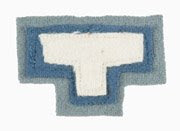
[Image] 20th Brigade Colour Patches

2/13th Infantry Battalion
New South Wales.

2/15th Infantry Battalion
Queensland.

2/17th Infantry Battalion
New South Wales.

These are the felt colour patches worn by the members of the 20th Brigade of the 9th Australian Division. The felt colour patch is worn on the upper outer sleeve of the tunic on both the left and right arms. They differ from other patches that were worn by other members of the AIF in the Second World War in that they are shaped like the letter 'T' whereas members of the 6th, 7th (except the 18th Brigade) and 8th Divisions wore a patch in the shape of a diamond separated into a top half colour and a bottom half colour.

The significance of the colour patches as worn by the 9th Division and members of the 18th Brigade of the 7th Division is that the shape has been varied from the AIF standard diamond to that of the letter 'T' in tribute to the Battalion's involvement in the defence of Tobruk. It was a badge that the Rat's wore with pride. When on leave everyone knew they were the one's who stopped Rommel in his tracks for so long.

The grey outline signifies the 9th Australian Division, the green border belongs to the 20th Brigade and the 'T' shape is in the individual battalion colours, the 2/13th was black, the 2/15th was purple and the 2/17th was white.

The changing of the colour patch's shapes, in recognition of the men involved in the Siege of Tobruk, has only ever been done this once in the entire history of the AIF.

This is one of the best indications of the significance of the action that the 9th Division was involved in at Tobruk was not lost on the Army. The Army changed nothing in recognition of deeds performed during World War One. This to me is one of the highest honours that the Army ever placed on the 9th Division.

colour patch images General Collection Australian War Memorial.

Saturday, August 2, 2008

[Image] 2/17th troops try out an Italian flak gun at Alamein

4 Sec, D Coy, 2/17th Infantry Battalion

The Italian Breda Model 35 20mm Anti-Aircraft Gun.

Men of 4 Section, D Coy. have a bit of fun on a captured Italian Breda Model 35 20mm cannon. These flak guns were primarily used in an anti-aircraft capacity however they had some use against soft targets like trucks, cars and infantry.

This photo was taken at Alamein in 1942 by my Grandfather, NX17811 Pvt. L.J. McCarthy of the 2/17th Infantry Battalion. This particular gun was popular amongst troops of the 2/17th for posing on for photos to send home. I have seen a photo of Jack Barber, also of the 2/17th and author of "The War, The Whores and the Afrika Korps", trying out the same gun in the photos within his book.

Click on the image for a high resolution copy.

image from the author's personal collection.

[Image] The Gateway to Fortress Tobruk

El-Adem Road Gateway, Red Line,

Tobruk, April, 1941.

The gateway to the heart of Tobruk and it's inner defenses and harbour lay through the southern approaching El-Adem Road. It is at this point that Rommel first probed the defenses of the Garrison in the Easter Battle of 1941.

This heavily fortified and defended position is guarded by Pvt. Earl of the 2/13th Battalion. I have not been able to identify this digger any further at this stage. He sits astride a concrete pillar with his Lee-Enfield .303 with fixed bayonet. Being on the line he is also wearing his Tin Hat.

The gateway was surrounded by an anti-tank ditch and huge amount of barbed wire. The steel poles set into the concrete could be slid back to allow access for approved vehicles. Interestingly, when Rommel's tanks did first attack Tobruk in this area they chose not to breech the line at this point. That was one of their only wise decisions that weekend.

image 007499 Australian War Memorial.

[Image] Monkey Business at Tobruk

Tobruk, Libya, 11th September, 1941.

Meet "Jerry" the monkey mascot of the 2/15th Battalion.

Pvt. Bob Leu of Mudgeeraba, Queensland, with "Jerry" a monkey soldiers from Queensland's 2/15th Battalion found in a captured German tank. "Jerry" was taken back to the Battalion HQ and enjoyed life from that day as the official mascot of the 2/15th Infantry Battalion.

Other photos exist of "Jerry" at Alamein and later in Syria with the 2/15th after pulling out of the Western Dersert. I currently don't know what happend to him after the Battalion's return to Australia in early 1943 but am eager to find out. I will let you know what I can work out.

image 020807 Australian War Memorial.

As at the time of writing I am unable to identify the service number of Pvt. Leu. I will endeavour to positively identify him and update the record accordingly.

Saturday, July 26, 2008

[Info] 9th Australian Division Structure 1941

In 1941 a reshuffle of Brigades and Battalions created the 9th Division. At this time the division consisted of the following forces (with home state in brackets);

Infantry Units

20th Brigade
- 2/13th Infantry Battalion (NSW)
- 2/15th Infantry Battalion (QLD)
- 2/17th Infantry Battalion (NSW)

24th Brigade
- 2/28th Infantry Battalion (WA)
- 2/32nd Infantry Battalion (VIC)
- 2/43rd Infantry Battalion (SA)

26th Brigade
- 2/23rd Infantry Battalion (VIC)
- 2/24th Infantry Battalion (VIC)
- 2/48th Infantry Battalion (SA)

Artillery Regiments
- 2/7th Field Regiment, Royal Australian Artillery
- 2/8th Field Regiment, Royal Australian Artillery
- 2/12th Field Regiment, Royal Australian Artillery
- 2/3rd Anti-Tank Regiment

Other Units
- 2/3rd Australian Machine Gun Regiment
- 2/4th Australian Pioneer Battalion
- 9th Australian Divisional Cavalry

Engineer Companies
- 2/3rd Field Company, Royal Australian Engineers (TAS/WA/SA)
- 2/13th Field Company, Royal Australian Engineers (QLD)
- 2/7th Field Company, Royal Australian Engineers (QLD)
- 2/4th Field Park Company, Royal Australian Engineers (WA)

This is a preliminary list of the structure of the 9th Division in 1941. I have horrible feeling that this list is incomplete so forgive me if I have left out information. It will be updated as and when I learn more.

Thursday, July 24, 2008

[Hero] NX15705 Cpl John Hurst Edmondson V.C.


2/17th Infantry Battalion, 20th Brigade, 9th Division


Cpl John Hurst "Jack" Edmondson was born in Wagga Wagga, NSW in 1914. He enlisted on 20th May 1940 at Paddington, NSW. Here he joined the newly formed 2/17th Infantry Battalion of the 7th Division. Due to his previous militia service he was quickly promoted to Corporal.

When the 7th Division embarked for Palestine in Oct 1940 little would they know that for some of them they would be arrive to be members of the newly formed 9th Division. As the divisions for WW2 were formed and numbered in the order of enlistment and began with the 6th Division (the 1st to 5th Divisions having been previously allocated for WW1) the members of the 7th Division were amongst the second wave of mass enlistments that occurred in early to mid 1940. The men of the former 7th Division were horrified to find themselves a part of the 9th Division. These men were often incorrectly labeled "The Long Thinkers" by the men of the 6th Division, a reference to the time it took for the men to decide to enlist.


With the 9th Division's deployment to Libya to relieve the 6th Division who were pulled out for the defence of Greece, Cpl Edmondson and his battalion (of whom my grandfather was a member) first engaged the German's in what was to be later known as "The Benghazi Handicap", the hasty retreat back to the shelter of the city of Tobruk.


Not long after arriving from this harrowing journey Cpl Edmondson's section was deployed on the outer perimeter of Tobruk's defences at post R33 in the Red Line. This was the area that was first attacked by Rommel's Panzer Division in what was to be known as "The Easter Battle".

Cpl. Edmondson's Victoria Cross was awarded posthumously (as too many are), for action during The Easter Battle of 13-14th April, 1941. The passage in the London Gazette of 1 July, 1941, gave the following details of Edmondson's deeds:


"On the night of 13th-14th April, 1941, a party of German infantry broke through the wire defences of Tobruk, and established themselves with numerous machine guns, mortars and field pieces. Led by an officer, Corporal Edmondson and five privates carried out a bayonet charge upon them under heavy fire. Although wounded in the neck and stomach Corporal Edmondson not only killed one of the enemy, but went to the assistance of his officer, who was attacked by a German from behind while bayoneting another who had seized him about the legs. Despite his wounds, from which he later died, Corporal Edmondson succeeded in killing these two Germans also, thus undoubtedly saving his officer's life."


John Hurst Edmondson's Victoria Cross was the first of twenty received by Australian Forces in WW2. As a result it carried with it quite a bit of propaganda value for the Allies who were in need of good news. John Edmondson's V.C. is currently on display in the Hall of Valour at the Australian War Memorial. John Hurst Edmondson V.C. is buried in the Tobruk War Cemetery.