Wednesday, August 27, 2008

[Image] Death of a Valentine

17th July, 1942. El Alamein, Egypt.

German shrapnel defeats the Allied Valentine Tank.

In a perfect example of why the allies needed heavier tank armour in the Western Desert this Valentine II Infantry tank has been disabled by shrapnel from German shelling. If shrapnel can be so devastating against an armoured target like this, it is horrifying to think of it's effect on infantry in the open ground of the Western Desert. This is a major reason casualties were so high at Alamein.

image 024552 Australian War Memorial.

[Image] Take that Germany!

5th October, 1942. El Alamein, Egypt.

9th Div troops mock Hitler.

These unidentified troops of the 9th Division skylark on a destroyed Mercedes Benz Battle Wagon in a mock salute to Hitler. It was common practice for many Australian troops to skylark in photos wearing pieces of captured German uniforms. A particular favourite, as worn by most of the Diggers in the above photo, is the German M35 Steel Helmet.

image 013356 Australian War Memorial.

[Image] The Western Desert Today

The Western Desert still has secrets.

This amazing image was taken by a tour guide in the Western Desert upon discovering the remains of an allied Chevrolet truck. Even after all the decades that have passed since the early 1940's the wreckage is in surprisingly good condition. The truck's engine was found half buried in the sand nearby.

image Long Range Desert Group Preservation Society http://www.lrdg.addr.com/images/GssLrdWas1.JPG

click on the image for a high resolution shot.

[Image] What direct hit Sir?

19th September, 1942. El Alamein, Egypt.

Two direct hits on an M3 Grant Tank.

This 8th Army M3 Grant Tank, or General Grant, has taken two direct hits on it's forward armour by German shell fire. These two hits, side by side, have dented the armour but done no real damage. These same hits would have destroyed an English Crusader Tank and likely killed the crew. Whilst far from perfect, the Grant had it over it's English predecessors in the one department that truly mattered, the armour. With much thicker armour, the operational life of the tank, and it's crew, was extended beyond that previously experienced.

The M3 Grant Tank was an interim measure taken by the British after the initial devastating defeats in the Western Desert by the Panzer Divisions. Lacking armour and firepower the British tanks were decimated by the much stronger Germans. After being refused permission to have American factories produce an English designed tank, the British resorted to purchasing the M3 Medium Tank from the United States.

Whilst slow, heavy, with a high profile and with an unusually mounted main gun, the M3 was used extensively in the Western Desert until the M4 Sherman became available. Once the Sherman's arrived in numbers the Grant was rapidly withdrawn from front line operations.

image 025032 Australian War Memorial.

[Image] Invaluable Aussie Advice


22nd July, 1942. Tel el Eisa, Egypt.

Good advice from the AIF?

The cabin door of this 9th Division ammunition truck is painted with either a timely piece of advice or a commentary on life in the Western Desert. In a typical display of Australian defiant humour the men who painted this sign leave it up to the reader to decide their intent.

image 024624 Australian War Memorial.

Sunday, August 24, 2008

[Image] A rare wash at Tobruk

June, 1941. Tobruk, Libya.

A rare chance to wash some clothes.

VX33235 Gunner J.W. Croft of the 2/3rd Light Anti-Aircraft Regiment has saved enough of his litre a day water ration to give some basic kit a wash. Gunner Croft hangs his washing to dry on a low slung washing line for a very good reason.

With the flat terrain at Tobruk, anything standing higher than three feet of the ground would draw artillery fire as being unnatural, and therefore enemy. For most men at Tobruk though, a wash in the ocean would be the closest they got to clean clothes.

One Digger recalled that for the entire duration of the siege he only once got a chance to wash, and that was a brief one hour trip to the beach. He also stated that he didn't brush his teeth for six months as it was a waste of precious water that could be drunk instead.

image p01260.012 Australian War Memorial.

[Image] A Lucky Escape at Alamein

November, 1942. El Alamein, Egypt.
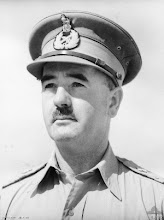
One Digger and a lucky escape.

This unidentified Digger of the 9th Division was wounded in both arms in the Second Battle of Alamein and captured by the Germans where he was transported, as a prisoner of war, to a German Dressing Station.

His wounds were treated by a German Medical Officer and when recovering the Dressing Station was captured by British Infantry where the Digger was released and returned to his Battalion. Here he is seen enjoying a smoke while catching up with excited mates.

image 042076 Australian War Memorial.

[Memorial] Australian War Memorial, Tobruk

Sunset.

16th October, 1941. Tobruk, Libya.

The unveiling of the Australian War Memorial.

This photograph was taken at the official ceremony to commemorate the unveiling of the tablet on the Australian War Memorial at the Tobruk War Cemetery. The memorial, built entirely by sappers of the Royal Australian Engineers, included a marble tablet inlaid at the base of the memorial.

The inscription reads;

"Here is hallowed ground, for here lie those that died for their country".

Major General Leslie Morshead officiated the official dedication of the war memorial to honour the Australian fallen of the Tobruk campaign. It would be some years before Maj. Gen. Morshead was to return to this site but return he did to honour his Rats of Tobruk.

image 020988 Australian War Memorial.

[Slang] Meet the Baitlayer

5th October, 1942. El Alamein, Egypt.
The baitlayer prepares his bait.

In another amusing example of Australian slang, the cooks of a battalion were referred to as "baitlayers". This derogatory term was a cheeky reference to the food being poisonous much like a bait for a wild animal.

In this picture the baitlayer is NX34516 Sapper Thomas M. O'Connor of the 2/4th Field Park Company, Royal Australian Engineers who has a reputation amongst the 9th Division as supposedly having 1001 recipies for bully beef. In this case he makes bully pancakes, which the men report as 99% pancake and 1% bully beef.

image 013357 Australian War Memorial.