Friday, August 15, 2008

[Image] The Hessian Spitfire of Tobruk


23rd September, 1941. Tobruk, Libya.

9th Division Sappers show off their hessian Spitfire.

Engineers from the 9th Division proudly display one of their latest achievements. A dummy Spitfire made from wood and hessian. Whilst boredom was a major obstacle of the Australian soldier in Tobruk, this display of modelling did have a military application.

The German's relied heavily on aerial reconnaissance of the Allied positions at Tobruk, with even Rommel himself known to fly his Storch occasionally for a personal view of the battlefield. With Allied aircraft numbers rapidly dwindling in the Western Desert with each sortie and the Luftwaffe possessing unprecedented air superiority a need for deception was required. Australian Sappers built these dummy aircraft to fool German reconnaissance pilots into thinking that Tobruk possessed a higher number of serviceable fighter planes than they actually did. They also served the added purpose of drawing Luftwaffe bombs away from actual planes, thus increasing their survival chances.

This campaign of deception was used again to great effect by Montgomery at Alamein where the widespread use of dummy troop trucks and tanks gave the Germans an inflated estimate the the Allied numbers that they were facing.

image 020685 Australian War Memorial.

Thursday, August 14, 2008

[Image] The business end of the Panzer Mk IV.

El Alamein, Egypt, 1942.

The business end of a Panzer Mk IV.

This amazing photo was taken by a member of the 9th Division at Alamein in 1942. This tank is the Panzerkampfwagen MkIV, or more commonly known as the Panzer MkIV. The MkIV was a masterpiece of German engineering. It was heavily armed and armoured and with the main 75mm gun it could deliver devastating firepower quickly.

In the Western Desert campaign there was initially very little in the allied arsenal that could cause the MkIV any concern. It had 100mm thick armour that could withstand almost anything fired at it. Unfortunately for this Panzer and it's crew the troops that disabled this war machine targeted the most vulnerable part of the German tank, it's tracks. Whilst there was very little that could penetrate it's armour there was however, a number of weapons that were capable of disabling the tracks. This particular tank carries a number of sections of spare track mounted across the front of the armour plate. A machine gun (likely an MG42) is turret mounted in a forward hard point. The salvage division vultures would soon be there to take it away for further use against Axis forces.

It was tanks such as these that first probed the 9th Division's positions along the El-Adem road during the Easter Battle of 1941 at Tobruk. Around 20 tanks, including some MkIV's, approached the lines of the 2/17th Battalion and stopped approximately 30 yards from the Aussies in the defensive posts. The above photo, whist taken at Alamein and disabled, still for me conjures up a horrifying image of what it must have been like for men like my Grandfather who were the first Australians to engage the tanks of the Panzer Divisions. It was also these same men, in this same battle, that gave the allies their first ever victory over the Germans on land.

It is not a fact widely known that Australian troops of the 9th Division were the first allied troops to defeat the Germans in battle on land. The Easter Battle of 1941 at Tobruk was the first time the allies had repulsed a German attack in the war to date. The motto of the 2/17th Infantry Battalion is "What we have, we hold". On this occasion just like the many more to follow, the 2/17th held their ground and won a decisive victory against superior numbers and equipment.

image p04734.011 Australian War Memorial.

[Image] Captured German mortar is stamped "Return to Sender"


Tobruk, Libya. 15th September, 1941.

The German 50mm Mortar.

This unidentified member of the 9th Division Salvage Unit demonstrates how easy it is to fire a captured German 50mm mortar. Equipment like this was invaluable to the Australians as at the time they occupied Tobruk, they were short of many items, especially weapons.

This 50mm Mortar was designed for use by infantry units. Ideally it would be operated by a crew of two. One to aim and steady the weapon, the other to fire it. Even with it's base plate it was still man portable. The High Explosive shells had an approximate rage of 500 yards and each shell weighed about 2.25lbs (approx 1kg). Many such mortars occupied the area known as "the salient" and they had a distinctive 'whoosh' sound when fired. Troops in forward posts would hear the sound of the mortar firing and would literally have a matter of seconds to take cover. In open ground these weapons can be devastating on soft targets like infantry.

The 9th Division's Salvage Unit was one of the most important units of the western desert campaign. Up until Alamein, the 9th Division was predominantly under equipped and poorly armed. Making use of captured enemy weapons and equipment soon became a necessity. The 9th Division Salvage Unit would be like ants at a picnic. Anything that could be salvaged from the battlefield and repaired, reused or recycled would be devoured and put back into the hands of the 9th Division's troops to use against their former owners. The Australian ability to scrounge and salvage was legendary.

image 020752 Australian War Memorial.

Saturday, August 9, 2008

[Image] German shells fall at Alamein

1st November, 1942. El Alamein, Egypt.

German shells burst in 9th Division positions.

Late on the afternoon of the 1st November, 1942, Australian positions at Alamein came under shell fire from German artillery. A shell explodes behind a large 9th Division truck. A lone digger can be seen running for the cover of the dug out in between the two trucks to the right of picture. This explosion is huge when compared to the size of the trucks in the foreground. This is not a barrage to be caught out in the open in.

image 042082 Australian War Memorial.

[Image] The true origins of Beach Cricket


September, 1942. El Alamein, Egypt.

The birth of beach cricket.

Australians have always loved sport and the outdoors. In spite of what beer company marketing gurus will tell you these photos don't lie. Australian troops of the 9th Division invented beach cricket during a spell in the beach area away from the front lines at Alamein in 1942.

Whilst not having the entire regulation kit nor proper grass wicket the troops of the 9th Division did what they do best. They made do with what they had. A bat, ball, stumps and even a set of pads and keeper's gloves were located and a sand wicket established.


"Slips Fieldsman"

"another cracking shot"

images 041992, 041993 and 041994 Australian War Memorial.

[Image] The Vickers of Tel el Eisa

Tel el Eisa, Egypt. July, 1942.

The Vickers Machine Gun at work on German positions.

NX25016 Pvt. Barrie Rymer and NX21498 Pvt. Paul Cullen of the 9th Divisions' Machine Gun Regiment fire their Vickers Machine Gun at German positions. This particular gun crew fired this gun at the German positions for two whole days. The spent cartridges burnt their hands and arms and they even used water from their own personal issue to keep the gun cool so that it would remain in action.

At the time of this action in 1942 the Vickers Machine Gun had been in service with allied forces for 30 years. It was water cooled, which meant it was heavier than air cooled machine guns and relied on a ready supply of water. The reservoir around the gun's barrel held 4.3 metric litres of water which boiled in the jacket around the barrel. This then converted to steam, which ran out a rubber hose at the back of the gun into a metal can to condense where it could be poured back into the jacket.

Whilst impractical in a desert environment the entire closed nature of the cooling system meant that there was no telltale steam emissions from the gun when fired allowing a Vickers crew to keep firing from fixed positions for longer before being given away. The constant need for water was a problem with many crews resorting to measures from using their own personal drinking water to urinating in the jacket. Any spare liquid would be pressed into service to cool a raging Vickers gun in action.

There was an action documented during WW1 at High Wood on 24th August, 1916 where a British Vickers gun regiment was tasked with keeping a large open area 2,000 yards away covered with suppressing fire for a period of 12 hours to ensure that the German infantry didn't form up for a large scale attack. Two entire infantry companies (several hundred men) were allocated to support these 10 guns with water, ammo and spare parts for the duration of the action.

Between them, and over the allotted 12 hour period, these 10 Vickers Guns fired one million rounds at the Germans. Barrels were changed every hour, a process that took a well trained crew two minutes and at the end of firing not one Vickers had broken down. It's easy to see then that the men pictured above could have easily fired for such an extended period.

With this kind of reliability it's no wonder the Vickers was used extensively in the desert by the 9th Division in spite of all it's inherent impracticalities.

image 041953 Australian War Memorial.

WW1 Vickers Gun anecdote source;

"Weapons & War Machines." by Ian V. Hogg & John Batchelor. London: Phoebus, p. 62 (1976).

Thursday, August 7, 2008

[Propaganda] 1941 AIF Recruitment Poster


"Mister, Here's Your Hat!"

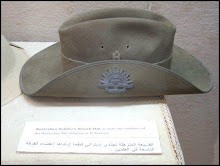
This AIF Recruitment poster, as published by the Department of the Army in 1941, was used to entice young men into enlisting in the Army. An attractive young woman hands an Army slouch hat to a prospective recruit.

How many men of the 9th Division were swayed into enlisting by the nameless girl will never be known, however I'm sure there were plenty of Diggers who wished they'd never laid eyes on her before.

In 1941, just like today, sex sells.

image ARTV06443 Australian War Memorial.

[Image] Thirsty work this desert warfare.


Western Desert, Egypt. 1st August, 1942.

Filling water cans at 9th Div HQ.

Fighting in the Western Desert is thirsty work, and none know just how thirsty like these men of 9th Division HQ who are filling water cans from the 500 gallon tanker in the picture.

Every single drop of water needed to be carted across the desert to the armies in the field. Rommel had more of a problem with the huge distance that his supply line had to transverse to get to the battlefields of Egypt. Water was a precious commodity, even more so when some could be spared from drinking for washing body and clothes.

Many Australians chose to drink their water and just rely on the occasional swim in the ocean at Alamein for all their bathing. The veterans of Tobruk were well versed in water rationing and had many novel ways to maximise the usefulness of even the tiniest amount.

image 024690 Australian War Memorial.

[Image] Bren Carriers at Tel el Eisa


Tel el Eisa, Egypt. 1st August, 1942.

Bren Carriers advance in support of 9th Division troops.

These Bren Gun Carriers are photographed at Tel el Eisa in support of an infantry advance by the 9th Division. The lead carrier seems to be mounting a Boys Anti-Tank Rifle in it's forward hardpoint whilst the unmistakable silhouette of the Bren Gun and bipod is visible out of the open topped carrier at the left.

image 041966 Australian War Memorial.