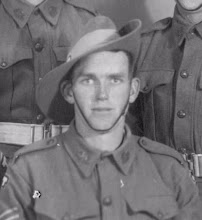
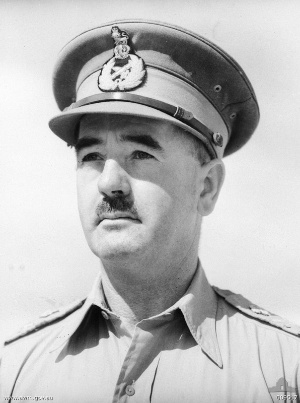
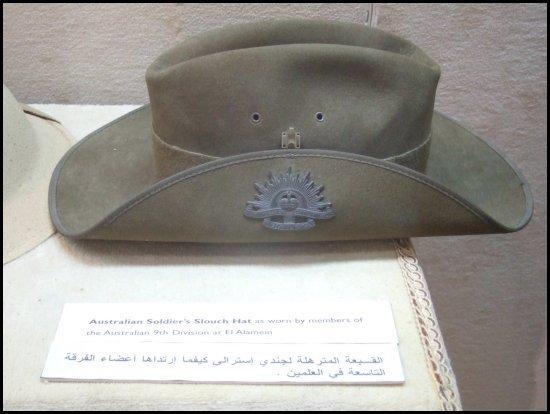
If you have any photographs or information on the 9th Division that you would like to share with The 9th Divvy (with full credit to you) please don't hesitate to contact the authour Tim Burke at snewinburke@optusnet.com.au
Thank You.
Tim.
Sunday, July 4, 2010

Saturday, April 10, 2010
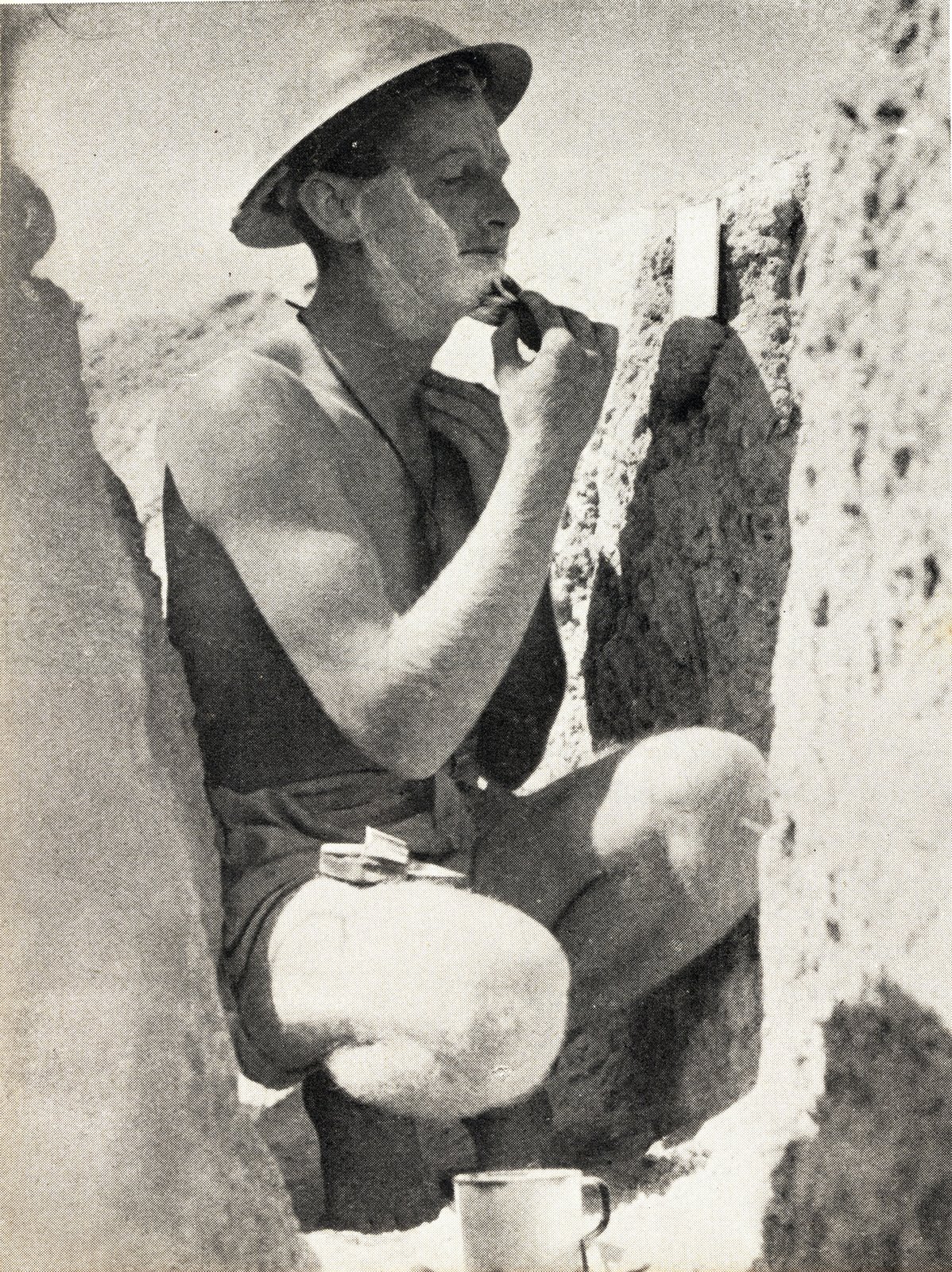
[Image] Cpl. John M. Munn 2/3rd Fd Coy RAE
 August 1941
Tobruk, Libya
This smiling face belongs to VX3645 Cpl. John Montgomery Munn of the 2/3rd Field Company of the Royal Australian Engineers. The caption with this photo at the Australian War Memorial is simply this;
"snow white hair bleached by the sun and skin tanned almost black"
The combination of these two traits and his missing front tooth ensures that Cpl Munn looks far older than his age of 35 years at the time of this photo being taken in August 1941 at the height of the Siege of Tobruk. The conditions that Australian troops served under in the Western Desert ensured that they aged much faster than normal, especially with their extended exposure to the harsh desert sun. In an era where sunblock and even sunglasses were unheard of the men of the 9th division's skin tanned a deep bronze very quickly, especially with the normal Australian soldier's tendancy to remove his shirt at any opportunity.
Upon their return to Australia in early 1943 it was said that it was quite easy to tell a returned man in a crowd due to their deep suntans. Cpl. Munn is a classic example of this.
Though Cpl Munn survived the rigours of Tobruk and Alamein he wasnt to be so lucky in New Guinea. At 1229hrs on September 24th, 1943 at Finschafen, New Guinea whilst the 2/3rd Field Company was supporting the artillery that was covering the advance of the infantry towards Satelberg a large force of Japanese aircraft consisting of 12 bombers and over 20 fighter aircraft bombed the artillery positions resulting in large casualties in the ranks of the engineers. Cpl. Munn was killed in this attack. He was aged 37 at the time of his death.
Cpl Munn is memorialised on the roll of honour at http://www.awm.gov.au/research/people/roll_of_honour/person.asp?p=533261
image 009522 Australian War Memorial.
Saturday, April 25, 2009
ANZAC Day
The Ode
They shall grow not old, as we that are left grow old:
Age shall not weary them, nor the years condemn
At the going down of the sun and in the morning
We will remember them.
From the poem "Ode to the Fallen" by Laurence Binyon, 1914.
They shall grow not old, as we that are left grow old:
Age shall not weary them, nor the years condemn
At the going down of the sun and in the morning
We will remember them.
From the poem "Ode to the Fallen" by Laurence Binyon, 1914.
Wednesday, September 17, 2008
[Image] An Ensign still flies on Ladybird
 3rd September, 1941. Tobruk Harbour, Libya.
The final resting place of HMS Ladybird.
Down but not out, a battered naval ensign still flies on the mast of HMS Ladybird as she rests stricken on the floor of Tobruk Harbour. Destroyed by dive bombers she was put to work as an anti-aircraft platform to destroy the very planes that sunk her.
HMS Ladybird was an insect class gunboat of the Royal Navy built in 1916 initially for patrol work along the River Danube during World War One. It was involved in the Panay incident in 1937 where Japanese artillery fired upon her near China. Posted to Singapore it was stripped down and towed to the Mediterranean in 1940.
Damaged sustained en route limited the Ladybird's speed to 7 kilometres per hour due to her misaligned hull. Stationed at Port Said in Egypt in a protective role it was utilised in one failed attack on an Italian island by a group of Royal Marines that saw it hit with an aerial bomb and severely damaged. Repaired it was then pressed into work as a part of the "Tobruk Ferry", the vital naval supply convoy that would restock Tobruk under cover of darkness with everything from reinforcements to ammunition, food and medical supplies. Tanks were even delivered to the garrison during the siege by the "Ferry".
It was during one such resupply operation on 12th May, 1941 that Ladybird was hit by dive bombers and set on fire. Settling on an even keel in 10 feet of water Ladybird's 3 inch guns were still functional and above the water line. Morshead immediately put the wreck and the deck guns to work as a static anti-aircraft platform. Men were stationed aboard the wreck to man the guns and even set up living quarters inside the wrecked hull.
Ladybird was damaged by aerial bombs and shrapnel many times during the siege but the men stationed aboard took down more than their fair share of Stukas by way of compensation.
images 020572 and 020569 Australian War Memorial.
 A 3 inch Deck gun on Ladybird.
[Image] Off for a quick dip
 June, 1941. Tobruk, Libya.
VX48227 Pvt. C.T. Jury at Cleopatra's Bath.
Pvt. Charles T. Jury of HQ 26th Brigade prepares to have a swim in what locals called "Cleopatra's Bath", supposedly a site favoured by the former Egyptian ruler for swimming.
This natural rock bath on the coast east of Tobruk was near the location of the 26th Brigade's HQ Company. It was said that the Pharaoh Cleopatra would swim in this rock pool and considered it one of her favourites. There are many sites along the North African coast that claim to be Cleopatra's Bath so to what extent this claim lies in truth is unknown. I hardly think that Pvt. Jury cares if the story is true or not. He is likely more concerned about getting as clean as possible.
image 020132 Australian War Memorial.
Sunday, September 14, 2008
[Image] Stuka attack on the 2/24th.
 30th April, 1941. Tobruk, Libya.
Stuka's bomb the 2/24th in the Red Line.
This amazing photo was taken from within a Carrier of the 2/48th Infantry Battalion as they approached the Red Line to offer assistance to the entrenched 2/24th. This attack was the second major thrust made by Rommel during the Siege and was heavily supported by artillery, tanks and infantry. The ever present Luftwaffe added the icing to the cake presented to the Diggers by their relentless dive bombing of the Red Line positions.
The Luftwaffe's aerial bombing was an attempt to demoralise the Australians and more importantly keep them underground in their Red Line posts whilst tanks and supporting infantry moved up to favourable positions in front of the anti-tank ditch.
This battle signalled the beginning of a period of bloody fighting that developed into the Battle of the Salient. This was one of the most trying and costly actions of the entire defense of Tobruk, for both sides.
The Carrier in the above photo has a Boys Anti-Tank Gun mounted in the forward gun position, the barrel of which can be seen protruding from the front of the photo. Also other tracks can be seen in the desert surface in front of the Carrier's direction of travel. These are most likely tracks from other Australian Carriers as opposed to Axis Tank tracks. The Axis tanks were a this stage of the battle concentrated to the front of the Red Line and not further back where this photo was taken.
No men were killed by the Stuka's bombs this day but on the day after this photo was taken 32 men from the 2/24th Infantry Battalion were killed in action in the Red Line.
image 128989 Australian War Memorial.
[Image] The Fig Tree R.A.P.
 30th September, 1941. Tobruk, Libya.
A wounded man arrives at the 'Fig Tree'.
This wounded Digger from the 2/17th Infantry Battalion is being carried into the mouth of the cave under the 'Fig Tree' Regimental Aid Post. Located just inside the Red Line, north of the Derna Road, the Fig Tree was the only feature in an otherwise barren desert. It was visible from both Hill 209 in the Salient and Carrier Hill behind that. As a result it was an easy target for the German Artillery and would be heavily shelled for several hours per day.
During the shelling men would be stuck underground in the cramped dirty conditions until it was safe to leave. It was a place to stabilise wounded before transferring them to the Australian General Hospital near the Harbour. It patched up the walking wounded and sent them back to the lines.
To this day the Fig Tree still stands in Tobruk.
 The Entry from the inside.
 Waiting in the cave for the shelling to stop.
images 021023, 021021 and 021026 Australian War Memorial.
Saturday, September 13, 2008
[Image] Unrewarded 2/13th Valour
 14th February, 1941. The Middle East.
NX14879 Cpl. J.T. Willis enjoys a quiet beer.
NX14879 Cpl. James Thomas Willis of the 2/13th Infantry Battalion enjoys a quiet beer somewhere in the Middle East prior to engaging in the action during the Benghazi Handicap that ultimately took his life.
A farm hand from Moree, north western NSW, Cpl. Thomas was in charge of a Bren Gun section that was posted near the road at the bottom of the pass at Er Reijima when they were surprised by the rapid advance of the German Panzer Tanks. Finding themselves suddenly under intense fire Cpl. Willis grabbed a Bren Gun and yelled at his men to withdraw whilst laying down a barrage of machine gun fire on the advancing Germans from a formation of rocks. This drew the fire of the tanks killing Cpl. Willis but his sacrifice did allow some of his men to escape, though unfortunately not all.
Cpl. Willis' unfaltering leadership and decisive action under fire undoubtedly saved the lives of some of his men that day but he has never been acknowledged by the Army with the posthumous awarding of any medal for valour under enemy fire.
I personally believe that Cpl. Willis met the criteria for the award of the Military Medal.
"On the 4th April, 1941 when under intense fire from German tanks and infantry he single handedly and without due regard for his personal safety did take charge of a Bren Light Machine Gun and whilst ordering his men to withdraw to safety lay down a barrage of covering fire to safeguard the retreat of his men and to draw the fire of the enemy onto himself, an action that he most certainly knew would likely result in his death."
"Whist Cpl. Willis' section did suffer casualties in the engagement his utmost attention to duty and to the safety of his men ensured that there were survivors. This would undoubtedly not have been the case if Cpl. Willis had not sacrificed his own life by drawing the enemy fire onto himself and thus away from his men."
Sounds like a citation for a Military Medal to me. You be the judge. Feel free to post your comments. I am eager to hear what you may think.
Cpl. James Thomas Willis is memorialised on the Roll of Honour here;
image p05238.001 Australian War Memorial.
[Image] United we Stand!
 22nd October, 1941. Tobruk, Libya.
The Men of Five Nations.
During the Siege of Tobruk the Men of 5 Nations were all that stood between Rommel and the Middle Eastern oil fields. Holding out at Tobruk, under siege by the German Afrika Korps and the Italian Army, these men made the German High Command commit far more troops and supplies to the maintenance of the siege than they were comfortable with, far weakening the Axis thrust into Egypt. It also denied Rommel the means of transporting the immense amount of supplies needed to wage a desert war via ship.
Everything the Axis used had to be transported by land across the desert from Tripoli, over a 1,000 miles away. Holding out for the 8 months that they did allowed the Allies to conclude negotiations with the United States for the supply of war materials that would ultimately arrive in time for the Battle of El Alamein in October, 1942.
The men that held the Axis at Tobruk, the only men entitled to be called 'Rats of Tobruk' came from (from left to right) Poland, Britain, India, Australia and Czechoslovakia.
Whilst this blogs primary focus is on the Australian 9th Division's contribution to the war effort the author acknowledges the sacrifice made by the men of all of these nations and I will endeavour to feature them when I have suitable material and a bit more time.
images 041852 and 041853 Australian War Memorial.

Saturday, September 6, 2008
[Image] The last men standing at Tobruk
 December, 1941. Tobruk, Libya.
The last Australians out of Tobruk.
These four men of the 2/13th Infantry Battalion were the last Australians to leave Tobruk. Legendary photographer, Damien Parer, took this shot of the men enjoying a meal. The 2/13th was the only Australian unit to see the Siege of Tobruk through in it's entirety after the Destroyer that was meant to evacuate them in October was sunk 60 miles short of Tobruk.
Not being able to be evacuated by sea the 2/13th fought their way out in the breakout that linked up with the 8th Army and were transported back to Alexandria by truck. Many men were killed and wounded in the breakout action but this was a major success that enabled the Battalion to be finally relieved.
The men in this photo, as taken by Parer, are;
NX36776 Pvt. Leslie E. Everett of Hay, NSW.
NX35738 L. Cpl. Alexander O'Connor of Wagga Wagga, NSW.
NX36799 Cpl. Gabriel Richardson of Yenda, NSW.
NX35348 L. Cpl John W. Cox of Grong Grong, NSW.
All these men survived the war to return home. The sense of relief on their faces belies the fact that worse is yet to come at Alamein in 1942.
image 010979 Australian War Memorial. Negative by Damien Parer.
[Image] Ack Ack Away!
 9th October, 1941. Tobruk, Libya.
3.7 inch Anti-Aircraft fire at night.
This amazing photo looks almost like a surreal model. Taken at night, without a flash, using only the illumination of the firing guns. The huge muzzle flashes light the area around for a large area. This means that the gun has to keep firing constantly to ensure that enemy aircraft can't get close enough to get an accurate shot away.
image 020906 Australian War Memorial.
[Image] 2/13th goes through the wire at R27.
 8th September, 1941. Tobruk, Libya.
Men of the 2/13th go through the wire.
These two men of the 2/13th are preparing to go through the wire on a small patrol out from post R27 in the Red Line. On the left holding Lee-Enfield .303 rifle with fixed bayonet is NX36511 Sgt. William F. Kubank. To his right is NX36399 Pvt. Stanley C. Hutton with the Thompson submachinegun.
Post R27 in the Red Line is opposite the El-Adem Escarpment, behind which camped the Afrika Korps. The low ground in front of the escarpment was covered extensively by German machine gun posts but these were regularly monitored and dealt with by nocturnal patrols into no-man's land.
image 020784 Australian War Memorial.
[Image] Departing Diggers leave their mark.
 20th September, 1941. Tobruk, Libya.
Soon to depart troops leave their mark.
Having been notified that they were to be relieved soon these Diggers decided to leave their marks on a former cafe in Tobruk.
Pictured from left to right are;
SX8509 Pvt. Archibald Lawrence Boyes of the 2/48th.
SX5207 Pvt. Torrence Ford Egan of the 2/48th.
VX40954 Pvt. William Neil Morris of the 2/48th. Pvt. Morris is having a joke by painting his name as "Ned Kelly".
All three men survived the war, especially the carnage of Alamein that was so devastating to the 2/48th Infantry Battalion.
image 020629 Australian War Memorial.
[Image] Relieved Rats arrive in Alex
 27th September, 1941. Alexandria, Egypt.
Relieved at last!
These 9th Division veterans of Tobruk manage a smile as they arrive via "bomb alley" to the safety of Alexandria, Egypt. Many of these first men to arrive were wounded and were amongst the priority evacuees.
Evacuated at night by destroyers of the Royal Navy and the Royal Australian Navy these ships would arrive on moonless nights and arrive, unload and take on passengers and cargo and then depart all within the space of half an hour. Once free of the harbour the next 60 miles of coastline was known as "bomb alley" as it was the last stretch of water before Egypt in range of Luftwaffe planes. Zigzagging at high speed to avoid bombers and to break up their wakes these ships were the lifeline of Tobruk Garrison. Everything coming into and going out of Tobruk during the siege travelled via this method.
Whilst the men in this photo have been individually numbered for identification purposes the notation with their names that accompanied it has long since been lost.
image 020470 Australian War Memorial.
[Image] An Incredible Escape Vol. 2
 August, 1941. Tobruk, Libya.
A 1,000 pound dud.
These four men of the 9th Division owe their lives to the Czechoslovakian resistance, many members of whom secretly work in Nazi Munitions plants in their occupied country against their will.
This 1,000 pound bomb (453.5 kilograms) contained huge amounts of high explosives but without their detonators they were inert weights. This particular bomb landed 20 feet from the anti-aircraft gun manned by the above Diggers. Amazed to still be alive the men inspected the dud after the attack and found in labeled "Made in Czechoslovakia" in non official markings.
This was not the only dud from Czechoslovakia to arrive at Tobruk during the siege. One memorable one, another 1,000 pounder landed in the town square and failed to detonate. When Engineers arrived to disarm it so it could be removed an examination of where the detonator should have been found a crumpled piece of paper with a handwritten note saying simply;
"From your friends in Czechoslovakia. I am sorry but this is all we can do to help right now".
image 009520 Australian War Memorial.
[Image] Tracers at Twilight.
 August, 1941. Tobruk Libya.
9th Division Bren Gunner opens fire at dusk.
With the glow of their illumination lighting their flight path these tracer bullets leave a visible sign of their passage at night as they rapidly pepper the German lines a mere 400 yards away.
This photo was taken during a fierce exchange of machine gun fire between the Aussies and the Germans on the Red Line. Twilight was a preferred time for attacks and counter-attacks as the dying light reduced the effectiveness of both machine guns and artillery. Tracer rounds assisted gunners in aiming their fire at night as they could see the path of their bullets. Problem is so could everyone else.
image 009492/14 Australian War Memorial.
[Image] An Incredible Escape
 22nd April, 1941. Tobruk, Libya.
The Benghazi Handicap's Wooden Spooners.
Meet two of the 9th Division's luckiest men. QX1698 Sapper Stanley Curtis and QX2454 Sapper Edward Hetherington-Harford of the 2/7th Field Company, Royal Australian Engineers enjoy a well received cigarette after their late arrival in Tobruk on foot after a 16 day trek.
Left behind in Benghazi to plant demolitions on Italian supply dumps so that the advancing Afrika Korps could not take advantage of them the two Sappers planted explosives to cover the 9th Divisions retreat, known as "the Benghazi Handicap". When surprised by the rapid approach of the advancing Afrika Korp the two men hid and were overtaken by Rommel's Panzer Divisions.
Finding themselves behind enemy lines and surrounded by thousands of Axis troops the men hid by day and travelled by night where possible overland on foot. After a journey of 16 days, and 300 miles (483 kilometres), the men managed to sneak past German positions surrounding Tobruk and return to their units. Immediately hospitalised for treatment of their injuries it is not known if the men played any further part in the Western Desert Campaign. If so I believe they well deserved any rest coming to them after that.
image 041710 Australian War Memorial.
[Image] A Rat in a Hole Vol 2.
 September, 1941. Tobruk, Libya.
A very creative doover.
This soldier of the 2/23rd Infantry Battalion takes shelter from the blistering sun of the Libyan desert in his doover improvised by hanging a hammock between the rocks of a sangar built on the side of a small rise.
In the shade, yet open to the breeze on one side the hammock would allow the air to circulate around the Digger and keep him as cool as possible in the situation.
image 020493 Australian War Memorial.
[Image] Rare reprieve for 2/23rd Captain.
 June, 1941. Tobruk, Libya.
VX15648 Capt. Edwin P. Tivey takes a rare break.
Capt. Ed Tivey of the 2/23rd Battalion takes a moment of quiet reflection to smoke a cigarette inside the dugout of the Headquarters of the 26th Brigade.
With conditions for officers at HQ areas better than those of the men at the front lines they were hardly luxurious. Often the positions of the HQ areas were plotted by German spotter planes and relayed to the artillery who then would launch a barrage of shells onto the locations. More than one HQ was destroyed by direct hits by the German artillery during the Western Desert Campaign.
Capt. Tivey would have been responsible for 4 platoons of infantry totalling 129 men. It is no wonder that a quiet cigarette in the solitude of his dugout would be a welcome relief from the pressures of command.
Unfortunately research into Capt. Tivey has revealed that he died from illness in Italy on 26th March, 1943. At the time of his death in an Italian POW camp, then promoted Major Tivey was 34 years old. As his service record is yet to be digitised by the National Archives I am unable to ascertain the circumstance behind his capture and transfer to Italy.
Major Edwin Peter Tivey is memorialised at the Roll of Honour here http://www.awm.gov.au/roh/person.asp?p=147-23753
image 020151 Australian War Memorial.
[Image] "The Seat of the Army"
 September, 1941. Tobruk, Libya.
The AIF Field Latrine.
This 9th Division Corporal shows off the type of field latrine used by Australian troop in front line positions at Tobruk. With typical Australian humour it was nicknamed "The seat of the Army".
Designed for use on the sandier parts of the desert, the digger would take a small shovel and dig a hole and place the "seat" over it and complete his task. Careful choice of your boghole's position was necessary to avoid detection by snipers and air attack.
image 021003 Australian War Memorial.
Subscribe to:
Posts (Atom)