Showing posts with label [North Africa]. Show all posts

Thursday, August 21, 2008

[Quote] Lt Gen Erwin Rommel

1941. North Africa.

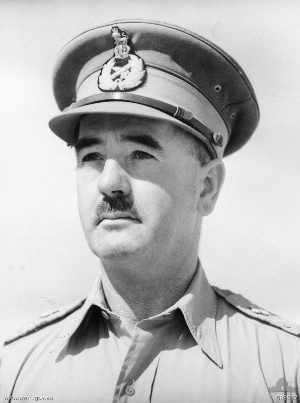
Lt General Erwin Rommel
GOC Deutsches Afrika Korps

Rommel, never one to hold back with his thoughts, when asked his opinion on the Australian 9th Division opposing him in Tobruk had this to say;

“The toughest but least disciplined troops in North Africa".

image p01112.001 Australian War Memorial.

Tuesday, August 5, 2008

[Image] 2/13th Mortar support at Tel el Eisa

Tel el Eisa, Egypt, 1st August, 1942.

A two pounder gets sent on its way.

NX16706 Pvt. Leslie S. Myers of the 2/13th Infantry battalion drops another two pound mortar shell into his launcher in support of the 9th Division advance at Tel el Eisa (The Hill of Jesus).

You can see what appear to be vehicles of some description on the horizon. Whatever they are they are above ground level and in this case a very valid target. You can see also a plume of smoke in the distance in the direction of fire of Pvt. Myers’ mortar. There also appears to be another dug in position several hundred yards in front of Pvt. Myers’ position. As he is firing live rounds in that direction my guess is that’s where Gerry calls home.

This photo taken not far above ground level can give you an appreciation of just how dangerous it would be to be caught in the open of the desert during a shell attack. Your only hope would appear to be to keep moving forward.

Pvt. Myers seems to have quite a bit about the top of his weapons pit. A Lee-Enfield .303 rests on the sandbags behind him as too does his cigarettes and matches. He looks like he has more mortar ammo to his right within easy reach and he is wearing the commonwealth Tin Hat with hessian cover.

To his left is what looks like a binoculars case. Makes sense that the guy with the mortar would have field glasses to spot targets with and to accurately gauge the range on enemy positions. Empty tins of bully beef can be seen in the foreground of the photo below. In the bottom photo Pvt. Myers looks like he has some kind of rangefinder or telescope.


images 0941967 and 041968 Australian War Memorial.

Saturday, August 2, 2008

[Image] Explosive End Vol. 3

Egypt, 1942.

A M3 Grant Tank falls victim to the "dreaded 88".

An unidentified Sgt. of the 2/3rd Anti-Tank Regiment of the 9th Division photographed the explosive aftermath of the American built M3 Grant when hit at close range by the German 88mm flak 36 Anti-Aircraft Gun. With absolute certainty the entire crew of this tank would have been killed instantly.

These 88mm Guns struck fear into the allies with their devastating effect and terrorising sound when fired. They were capable of penetrating 100mm of armour at 400 yards. By the looks of the outcome on the more heavily armoured M3 this one was fired upon by an extremely close 88. In the western desert these guns were sometimes dug into the ground to create a fixed position. An example of one of these guns is shown below.


November, 1942, Libya.

A dug in German 88mm Flak 36 Anti-Tank Gun.

Australian troops inspect the much feared German 88mm flak gun. This particular gun was dug in to the sand of the Western Desert to protect the crew from shell fire from allied tanks by creating a much lower profile.

Digging the gun in allowed the crew to fire on a distant allied tank much easier as to raise the arm of the gun up high to fire on a distant target in the flat terrain of the desert meant that you were likely to be more easily targeted with return fire. A smaller profile meant you were a smaller target and therefore, in theory, much harder to hit.

For the crew of this 88, the theory was disproven as when Australian troops arrived to inspect the gun they found the entire crew buried nearby.

images p01393.010 and 040977 Australian War Memorial.

Sunday, July 27, 2008

[Medal: Allies] The Africa Star

The Africa Star (with 8th Army Clasp)

The Africa Star is a Commonwealth medal awarded for operational service in North Africa from 10th June, 1940 (Italy's entry to WW2) until 12th May, 1943 (defeat of Axis forces in Africa).

Three clasps are available for wear on the Africa Star. Those representing the 1st Army, 8th Army and Commonwealth troops serving in North Africa during 1942-1943.

The medal pictured has the 8th Army clasp attached to the ribbon. This means that the recipient served on active duty in North Africa under Field Marshall Bernard Law Montgomery as a member of the British 8th Army. The 9th Division was attached to the 8th Army for the period of the Alamein campaign from July to November, 1942.

The medal itself is a six pointed star of yellow copper zinc alloy. The obverse has a central design of the Royal and Imperial cypher, surmounted by a crown. The cypher is surrounded by a circlet containing the words ‘The Africa Star'. Stars issued to Australian personnel have recipient names and service numbers engraved on the plain reverse.

The red on the ribbon symbolises the Army, the sky blue the Air Force and the dark blue the Navy. The yellow represents the Western Desert.

An unnamed Africa Star with an 8th Army clasp in good original condition will sell for up to $100 on eBay. A named version (which all Australian Africa Stars were) will sell for more than an unnamed one. Personally my Grandfather's medals are priceless and no amount of money would see them leave the family.