Showing posts with label [Tin Hat]. Show all posts

Saturday, September 6, 2008

[Image] An Incredible Escape Vol. 2

August, 1941. Tobruk, Libya.

A 1,000 pound dud.

These four men of the 9th Division owe their lives to the Czechoslovakian resistance, many members of whom secretly work in Nazi Munitions plants in their occupied country against their will.

This 1,000 pound bomb (453.5 kilograms) contained huge amounts of high explosives but without their detonators they were inert weights. This particular bomb landed 20 feet from the anti-aircraft gun manned by the above Diggers. Amazed to still be alive the men inspected the dud after the attack and found in labeled "Made in Czechoslovakia" in non official markings.

This was not the only dud from Czechoslovakia to arrive at Tobruk during the siege. One memorable one, another 1,000 pounder landed in the town square and failed to detonate. When Engineers arrived to disarm it so it could be removed an examination of where the detonator should have been found a crumpled piece of paper with a handwritten note saying simply;

"From your friends in Czechoslovakia. I am sorry but this is all we can do to help right now".

image 009520 Australian War Memorial.

Monday, September 1, 2008

[Image] Tommy got you covered

1st September, 1941. Tobruk, Libya.

VX31704 Cpl. Warwick Brownrigg & his Thompson.

VX31704 Cpl. W. Brownrigg aims his American made Thompson sub machine gun out a firing slot in the sandbag defences of his position in the Red Line of Tobruk's outer perimeter.

Cpl. Brownrigg, of the 2/23rd Infantry Battalion out of Victoria, featured in a number of photos taken at the time by members of the Military History and Information Unit. In this one he has a rare Tommy Gun with a larger 50 round drum magazine inserted. It also has the fore grip fitted, which with the added weight of the larger magazine made it a necessity for semi-accurate firing.

Cpl. Brownrigg is listed as having been discharged from the Army on 22nd October, 1942. As his service record has not been digitised by the National Archives I am unable to say for certain why. I suspect that his discharge date being so close to the date of the Second Battle of El Alamein that he may have been so severely wounded that he was not expected to be able to return to service and thus discharged. At this stage this is nothing more than an educated guess.

image 020503 Australian War Memorial.

Sunday, August 17, 2008

[Image] The Digger of Alamein

The Australian Digger, Alamein 1942.

This photo taken at the Alamein War Museum in Egypt shows the typical Australian Infantry soldier of the Western Desert of 1942. A Lee-Enfield .303 rifle, a bayonet and of course the tin hat are ever present.

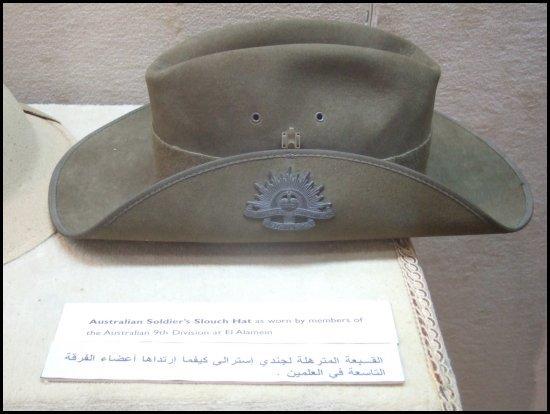
Several things differ between the model soldier here and photos of actual Aussie soldiers at Alamein that are worth mentioning. I think that this photo is how the regulation Australian soldier should have looked. In reality the Australian soldier at Alamein was most likely bare chested. He was more likely to wear a slouch hat than a tin hat and was more often than not bare footed. This Digger is also way too white in skin tone to have spent any length of time in the Western Desert.

The Diggers of the 9th Division may have gone away white but came back the very image of the 'bronzed aussie'. This was an era decades before sunscreen. As a result skin cancers were a huge concern for returned men of the 9th Division even way into their latter years. For some it wasn't the Germans that killed them but the Western Desert sun itself many decades later.

The Australians were a casual lot with their uniforms in all theatres of the second world war. This is what makes some of the photos even more powerful because of the contrast in their casual appearance and the horrible nature of their surroundings.

image Alamein War Museum, Egypt.

Saturday, August 16, 2008

[Image] Tobruk's Anti Aircraft Defenses

6th September, 1941. Tobruk, Libya.

VX24598 Bombardier E.J. Courtney MM

VX24598 Bombardier Edward James Courtney of the 2/3rd Light Anti Aircraft Regiment, attached to the 9th Division demonstrates the Italian Breda Model 35 20mm cannon that he won his Military Medal on.

His citation for the Military Medal reads;

"For bravery and devotion to his duties in an A.A. detachment whilst under heavy dive bombing and machine gun fire."

At Tobruk on 25th April and 7th May, 1941.

"1. On 25th April at Pilastrino when over forty E.A. (Enemy Aircraft) took part, the Breda gun on which Gnr Courtney was a gun number had a stoppage during the engagement. The detachment took cover, with the exception of Gnr Courtney who remained at his post working to free the stoppage in spite of heavy machine gun fire and near bomb explosions, and succeeded in getting the gun into action again and enabling to detachment to reengage the E.A."

"2. On 7th May when protecting a troop of 60-pdr. guns in another dive bombing attack, Gnr Courtney's gun again had a stoppage. He preceded to clear the stoppage despite the fact that three ME.110's were machine gunning along the ridge and several of the bullets entered the gun pit narrowly missing him while he was working. Through his efforts the gun was eventually brought back into action."

Another classic example of Australian troops using a captured Italian gun against German aircraft. If it would shoot Aussies would use it.

VX24598 Bombardier E.J. Courtney MM's entire service record has been digitised by the Australian National Archives. Find the link in the "Research Links" sidebar to the right.

image 020589 Australian War Memorial.

[Image] German War Graves at Alamein

September 1942, El Alamein, Egypt.

German War Graves found inside Australian positions.

When the Germans attacked 9th Division positions in September 1942 at Alamein they took a portion of the Australian minefield and held it for a number of days until a counter attack dislodged them.

During this time the Germans buried a number of their dead that had fallen in the no mans land between forward positions. Both sides buried each others dead if it was safe to do so. The men who occupy these graves were buried during this brief period. The Germans brought with them a supply of ready made wooden crosses in anticipation of having to perform this task.

An unidentified Tommy Gunner of the 9th Division looks on at the final resting place of the men who were his enemy.

image 042007 Australian War Memorial.

Saturday, August 9, 2008

[Image] The Vickers of Tel el Eisa

Tel el Eisa, Egypt. July, 1942.

The Vickers Machine Gun at work on German positions.

NX25016 Pvt. Barrie Rymer and NX21498 Pvt. Paul Cullen of the 9th Divisions' Machine Gun Regiment fire their Vickers Machine Gun at German positions. This particular gun crew fired this gun at the German positions for two whole days. The spent cartridges burnt their hands and arms and they even used water from their own personal issue to keep the gun cool so that it would remain in action.

At the time of this action in 1942 the Vickers Machine Gun had been in service with allied forces for 30 years. It was water cooled, which meant it was heavier than air cooled machine guns and relied on a ready supply of water. The reservoir around the gun's barrel held 4.3 metric litres of water which boiled in the jacket around the barrel. This then converted to steam, which ran out a rubber hose at the back of the gun into a metal can to condense where it could be poured back into the jacket.

Whilst impractical in a desert environment the entire closed nature of the cooling system meant that there was no telltale steam emissions from the gun when fired allowing a Vickers crew to keep firing from fixed positions for longer before being given away. The constant need for water was a problem with many crews resorting to measures from using their own personal drinking water to urinating in the jacket. Any spare liquid would be pressed into service to cool a raging Vickers gun in action.

There was an action documented during WW1 at High Wood on 24th August, 1916 where a British Vickers gun regiment was tasked with keeping a large open area 2,000 yards away covered with suppressing fire for a period of 12 hours to ensure that the German infantry didn't form up for a large scale attack. Two entire infantry companies (several hundred men) were allocated to support these 10 guns with water, ammo and spare parts for the duration of the action.

Between them, and over the allotted 12 hour period, these 10 Vickers Guns fired one million rounds at the Germans. Barrels were changed every hour, a process that took a well trained crew two minutes and at the end of firing not one Vickers had broken down. It's easy to see then that the men pictured above could have easily fired for such an extended period.

With this kind of reliability it's no wonder the Vickers was used extensively in the desert by the 9th Division in spite of all it's inherent impracticalities.

image 041953 Australian War Memorial.

WW1 Vickers Gun anecdote source;

"Weapons & War Machines." by Ian V. Hogg & John Batchelor. London: Phoebus, p. 62 (1976).

Tuesday, August 5, 2008

[Image] 2/13th Mortar support at Tel el Eisa

Tel el Eisa, Egypt, 1st August, 1942.

A two pounder gets sent on its way.

NX16706 Pvt. Leslie S. Myers of the 2/13th Infantry battalion drops another two pound mortar shell into his launcher in support of the 9th Division advance at Tel el Eisa (The Hill of Jesus).

You can see what appear to be vehicles of some description on the horizon. Whatever they are they are above ground level and in this case a very valid target. You can see also a plume of smoke in the distance in the direction of fire of Pvt. Myers’ mortar. There also appears to be another dug in position several hundred yards in front of Pvt. Myers’ position. As he is firing live rounds in that direction my guess is that’s where Gerry calls home.

This photo taken not far above ground level can give you an appreciation of just how dangerous it would be to be caught in the open of the desert during a shell attack. Your only hope would appear to be to keep moving forward.

Pvt. Myers seems to have quite a bit about the top of his weapons pit. A Lee-Enfield .303 rests on the sandbags behind him as too does his cigarettes and matches. He looks like he has more mortar ammo to his right within easy reach and he is wearing the commonwealth Tin Hat with hessian cover.

To his left is what looks like a binoculars case. Makes sense that the guy with the mortar would have field glasses to spot targets with and to accurately gauge the range on enemy positions. Empty tins of bully beef can be seen in the foreground of the photo below. In the bottom photo Pvt. Myers looks like he has some kind of rangefinder or telescope.


images 0941967 and 041968 Australian War Memorial.

Saturday, August 2, 2008

[Image] The faces of the 2/32nd at Alamein

El Alamein, Egypt.

Men of the 2/32nd Battalion and their Bren Carrier

Three unidentified members of the 2/32nd Infantry Battalion pose alongside their Bren Gun Carrier at Alamein. They wear three different types of headgear from left to right: slouch hat, woollen beanie and tin hat.

The soldier on the right carries a trophy of war, a German Mauser Kar98 Rifle while the man in the middle wields a machete, a rather unusual choice given the desert location and in all likelihood this was not standard issue equipment for the Western Desert. He also appears to wear some kind of tinted goggles or sunglasses, a rather rare commodity at Alamein.

image p02522.005 Australian War Memorial.

Friday, August 1, 2008

[Image] Inside a Rat of Tobruk's nest


Tobruk, Libya, July 1941.

In the dug out of the Officers of the 2/24th Battalion.

This heavily sandbagged weapons pit in the Red Line of Tobruk is temporary home to VX48780 Capt. G.G. Anderson and VX48694 Capt. G.I "Ian" Malloch M.C. of the 2/24th Infantry Battalion.

This weapons pit appears roomier than other examples seen with ordinary ranks. That aside it is very much a functional structure. The highly sandbagged walls protected the men from shell burst, machine gun and sniper fire, provided that they kept their heads below the level of the sandbags. Note between the Captains is a rectangular firing slot in the sandbags to allow for weapons fire through the protective wall. German snipers were know to shoot men through these holes at ranges of 400 yards. A Lee-Enfield .303 rifle stands against the wall in the foreground. Both men wear the standard commonwealth Tin Hat, but this time with hessian covers.

VX48694 Capt. George Ian Malloch M.C. (right) was awarded the Military Cross for "conspicuous gallantry and devotion to duty" at Tobruk on 17th May 1941 for leading a counter attack on a heavily defended German position above an escarpment about 50 metres high. Despite being shot 5 times in the arm, head, knee, thigh and hand and incapacitated he kept his calm and successful ordered his men from his fallen position. This resulted in the position being taken and saved the lives of many men. Staying calm in spite of grievous injuries and keeping on task set an example amongst the men of the 2/24th that filled them with pride to serve with such an officer.

VX48780 Capt. Graham Grantham Anderson (left) died of wounds (D.O.W) received in the first Battle of El-Alamein on 13th July, 1942. At the time of his death he was 23 years old. Capt. Anderson is memorialised at the Australian Roll of Honour here:


The National Archives of Australia has a completely digitised version of VX48694 Capt. G.I Malloch M.C.'s service record. Included in this is the originally submitted citation recommending him for the Military Cross (page 28 of record). View Capt. Malloch's Service Record here:


(Enter Capt. Malloch's service number "VX48694" in the key word field, hit "enter", then click on the "View digital copy" link.)


image p00237.036 Australian War Memorial.

Sunday, July 27, 2008

[Image] 2/23rd Bren Gunner at Tobruk

3rd September, 1941
Tobruk, Libya.

VX26227 Pvt. George E. Jeffs, 2/23rd Infantry Battalion

Private Jeffs mans a Bren Gun in a weapons pit on the Red Line at Tobruk. This is a great photo of the tripod mounted Bren light machinegun (LMG) in action from a perspective not often seen in Australian war photos. The smiling face of Pvt. Jeffs adds a very Australian charm to it. Pvt. Jeffs wears his Tin Hat high on his brow so that when prone he can see down the sights of his Bren gun whilst dispensing .303 calibre welcoming presents to "Gerry".

Sadly, Private Jeffs survived all that the Axis had to offer in North Africa only to be Killed In Action (K.I.A.) by the Japanese at the Quoja river region, New Guinea on 17th November, 1943. At the time of his death (the promoted) Cpl. George Edward Jeffs was 24 years old.

VX26227 Cpl. G.E. Jeffs is memorialised on the Roll of Honour here: http://www.awm.gov.au/roh/person.asp?p=147-11899

image 020558 Australian War Memorial.

Saturday, July 26, 2008

[Image] 9th Division Digger at Alamein

3rd November, 1942
El Alamein, Egypt.

An Australian Digger of the 9th Division menaces with bayonet fixed on his Lee-Enfield .303 rifle. He wears the standard Commonwealth Tin Hat and his shirt looks bleached from the North African sun.

Unfortunately the identity of this soldier is unknown but I wouldn't stand in his way. Many a German or Italian would have felt the same when confronted by this bloke and his bayonet. The Australian bayonet used in WW2 was a surplus item from WW1. It was quite long and had a very intimidating look when fixed (as is obvious from the photo above). Many an Axis soldier feared the Australian wielding a fixed bayonet.

image 042078 Australian War Memorial.

Friday, July 25, 2008

[Image] Sep 1942. Mortar attack on 9th Division positions

September 1942 Ruin Ridge, Alamein Sector, Egypt

Australian 9th Division troops under fire from enemy mortar attack atop Ruin Ridge, Alamein sector, Egypt. These troops shelter in a standard slit trench dug waist deep and reinforced with sand bags, rocks and anything capable of forming a barrier between shrapnel and flesh. Tin hats are the order of the day while in typical Australian fashion shirts are not. The Sergeant (with the shirt) is holding a pair of binoculars searching for any sign of where the mortars are being fired at them from.

image 151150 Australian War Memorial