Showing posts with label [Rats of Tobruk]. Show all posts

Saturday, September 13, 2008

[Image] United we Stand!

22nd October, 1941. Tobruk, Libya.

The Men of Five Nations.

During the Siege of Tobruk the Men of 5 Nations were all that stood between Rommel and the Middle Eastern oil fields. Holding out at Tobruk, under siege by the German Afrika Korps and the Italian Army, these men made the German High Command commit far more troops and supplies to the maintenance of the siege than they were comfortable with, far weakening the Axis thrust into Egypt. It also denied Rommel the means of transporting the immense amount of supplies needed to wage a desert war via ship.

Everything the Axis used had to be transported by land across the desert from Tripoli, over a 1,000 miles away. Holding out for the 8 months that they did allowed the Allies to conclude negotiations with the United States for the supply of war materials that would ultimately arrive in time for the Battle of El Alamein in October, 1942.

The men that held the Axis at Tobruk, the only men entitled to be called 'Rats of Tobruk' came from (from left to right) Poland, Britain, India, Australia and Czechoslovakia.

Whilst this blogs primary focus is on the Australian 9th Division's contribution to the war effort the author acknowledges the sacrifice made by the men of all of these nations and I will endeavour to feature them when I have suitable material and a bit more time.

images 041852 and 041853 Australian War Memorial.


Friday, September 5, 2008

[Image] A Rat in a Hole

August, 1941. Tobruk, Libya.

A Rat in a Red Line hole.

Pvt. J. Collins escapes from German shelling in his doover. Pvt. Collins has been able to scrounge wood and metal to brace the walls and roof of his hole in the ground. Men spent incredible lengths of time laying about in holes just like these. It was not uncommon to have to lie in your slit trench all day in blistering heat with little water, having to relieve yourself in a old fruit tin, any movement above the surface would draw the fire of the Germans.

Pvt. Collins has letters from home in the rafters of his shelter. This is obviously a more long term doover, as one would construct during an extended period in the front lines. This photo was taken during a German artillery attack on Red Line positions. This would keep the Diggers underground for extended periods in cramped, hot and dusty conditions. Depending on the time of the shelling men in the Red Line ran the risk of missing out on their one hot meal a day if the rations trucks were attacked.

image 009513 Australian War Memorial.
I have been unable to positively identify Pvt. J Collins as there were 217 men with that name that served in the Army during WW2. If time permits in the future I will attempt to make a positive identification.

Friday, August 29, 2008

[Quote] Lt. Tas Gill, 2/48th Battalion

1st June, 1941. Tobruk, Libya.

Lt. Tas Gill, 2/48th Battalion.

Lt. Tas Gill of the 2/48th Battalion pictured above at the extreme right with mates in Palestine in 1941 had this to say about conditions at Tobruk;

"Today has been distressingly hot, about 115 I should think. Consider your plight for a moment - living in shallow holes in rocky ground, not a tree with[in] hundreds of miles, no shade except what we make with bits of wood and so on, none of the luxuries of life such as eats and drinks, and nowhere to go and no respite."

For those of you who like me live in a metric world, 115 degrees Fahrenheit is 46.1 degrees Celsius. That is hot.

image p00237.042 Australian War Memorial.
Sunday, August 24, 2008

[Memorial] Australian War Memorial, Tobruk

Sunset.

16th October, 1941. Tobruk, Libya.

The unveiling of the Australian War Memorial.

This photograph was taken at the official ceremony to commemorate the unveiling of the tablet on the Australian War Memorial at the Tobruk War Cemetery. The memorial, built entirely by sappers of the Royal Australian Engineers, included a marble tablet inlaid at the base of the memorial.

The inscription reads;

"Here is hallowed ground, for here lie those that died for their country".

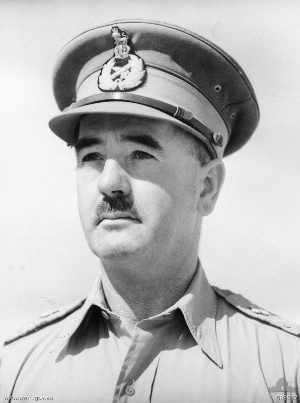
Major General Leslie Morshead officiated the official dedication of the war memorial to honour the Australian fallen of the Tobruk campaign. It would be some years before Maj. Gen. Morshead was to return to this site but return he did to honour his Rats of Tobruk.

image 020988 Australian War Memorial.

Wednesday, July 30, 2008

[Heraldry] Rats of Tobruk Association


Rats of Tobruk Association Crest

This is the crest of the Rats of Tobruk Association. It is a group set up by veterans of Tobruk as a means of keeping in contact and raising awareness of the actions of the men of the AIF at Tobruk.

This particular crest is scanned off a window decal that was in my Grandfather's personal items. It's old and never been used. At first I wondered why Grandad wouldn't have put the decal on the back window of his car and then I remembered that when I was young he drove a Toyota Corona. I also remember that he hated the fact that he couldn't afford to drive an Australian built car, as they were more expensive at the time. I never heard him say anything about the Germans commiting war crimes in the Middle East. He did however, never have anything nice to say about the Japanese.

Realising now just what my Grandfather faced at the hands of the Japanese forces in the jungles of New Guinea and Borneo it's no wonder that he just couldn't bring himself to put his Rats of Tobruk decal on his Toyota.

Rats of Tobruk Association window decal from the author's private collection.

Tuesday, July 29, 2008

[Image] The Baby Faced 'Rat of Tobruk'


11th May, 1942. Beirut, Lebanon.

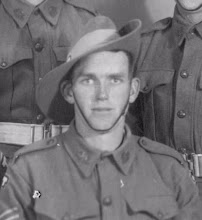
NX21849 Pvt. Elson Evered Bell on leave, aged 18 years.

If you are thinking that Pvt. Bell of the 2/17th Infantry Battalion looks young, that's because he was. Following in the time honoured Australian tradition of not being entirely truthful about your age to go to war Pvt. Bell bumped up his age by 5 years to meet the strict age requirements of the Second A.I.F.

Being only 16 years, 7 months old when he enlisted on 27th May 1940 (the day before my Grandfather) Pvt. Bell was the youngest man Mentioned in Despatches (MiD) at Tobruk.

The Australian War Memorial writes "Private K E Bell, A Company, 2/17th Infantry Battalion ... was aged 17 years when he was Mentioned in Despatches for bravery at Tobruk. During an offensive patrol he carried in his officer although wounded himself. The officer later died."

The Australian War Memorial credits this photo as being of Pvt. K. E. Bell of the 2/17th Battallion. My personal research has led me to believe that the baby faced Rat of Tobruk was actually Pvt. E. E. Bell who was, like the AWM states, a member of A Coy. 2/17th Battalion who was Mentioned in Despatches and wounded in Tobruk.

The nominal roll of the 2/17th Battalion shows only one soldier with a surname of Bell who was wounded at Tobruk, and no soldier with a name of K.E. Bell. The nominal roll of the 2/17th lists his service number as NX21849 and also mentioned was the fact that he was wounded not only at Tobruk, but also Alamein and New Guinea. He was discharged on 30th November, 1945 having just celebrated his actual 21st birthday the month before. How bizarre to think that Pvt. Bell fought a World War for 5 years and won all before his 21st birthday.

They don't make 'em like him anymore.

image 024225 Australian War Memorial

Nominal roll research from "What we have, we hold - A history of the 2/17th Australian Infantry Battalion", 2/17th Battalion History Committee, Sydney.