Friday, August 1, 2008

[Image] A "Boys" own adventure


Tobruk, Libya, 11th September, 1941

Meet the .55in Boys Anti-Tank Rifle.

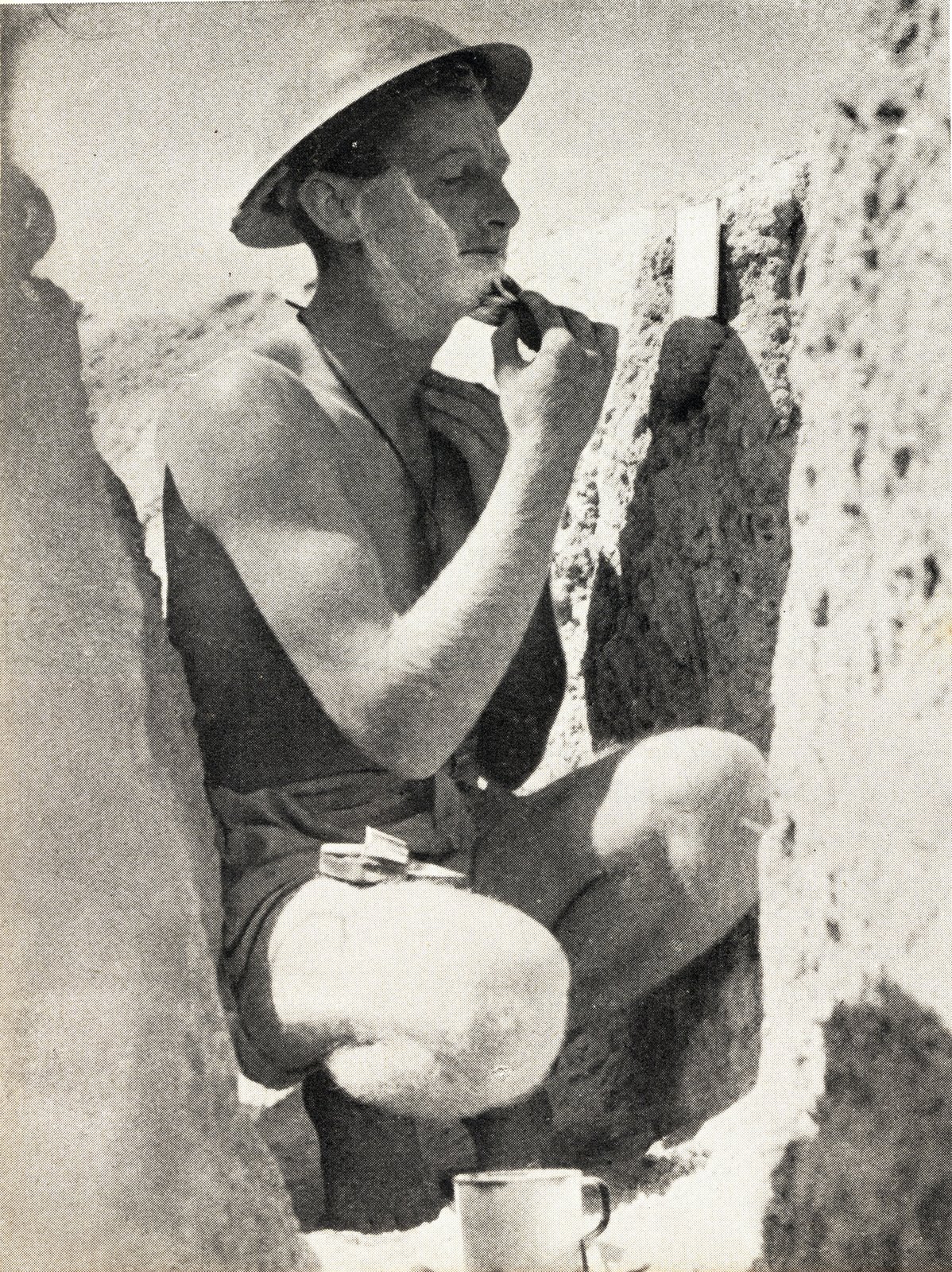
VX18855 Gunner Jeff Coombe of the 9th Division's 2/3rd Anti-Tank Regiment demonstrates how to deploy the .55in (13.9mm) Boys Anti-Tank Rifle in the Libyan desert.

Often in short supply in the early stages of the siege, the Boys (often incorrectly spelt "Boyes") Anti-Tank rifle is a bolt actioned weapon with a 5 shot magazine. It was sometimes known as "Charlie the bastard" amongst the 9th Division troops as a reference to the heavy recoil experienced when firing the gun when compared to other smaller calibre weapons available to them at the time.

Capable of firing two different types of cartridges, the W1 and W2, with the W2 being able to penetrate 20mm of armour at 100 yards. The weapon was effective against "hard" targets (armour) out to 300 yards and against "soft" targets (infantry") to a much longer range with devastating effect.

Having initial success against the lighter armoured Italian tanks and some of the earlier model German tanks, the Boys rapidly became obsolete in the Western Desert due to the increasing thickness of the armour of subsequent models of German tank. It was still capable however, of causing casualties to machine gun nests and smaller infantry fortifications and in the absence of anything better the 9th Division simply made the most of what they had, an all to common occurrence in Tobruk.

image 020723 Australian War Memorial.

[Image] Cairo, Egypt.


"View of ancient portion of Cairo".

image by NX17811 Cpl. L.J. McCarthy, 2/17th Infantry Battalion from the author's personal collection.

Click on image to enlarge.

[Map] Siege of Tobruk, 1941.

The Siege of Tobruk

Libya, 1941.

This is a map of Siege of Tobruk, as defended by the 9th Division, from April to November, 1941. You can see the both the Red and Blue lines as well as post numbers and dispositions of the Royal Horse Artillery guns.

Post R49, as discussed in the previous article "Post R49 Tobruk Explained" is located on the Red Line to the east of the El-Adem road. The locations of major battles is also shown.

Click on the image to expand it.


image from "The War, The Whores and the Afrika Korps". by NX34089 Cpl. Jack Barber, 2/17th Infantry Battalion, 1997, Kangaroo Press, Sydney.

[Image] The hard yards done at Tobruk

Tobruk, Libya. 11th September, 1941.

The worn out boots of the 9th Division.

An unidentified Army boot maker wonders what to do with the huge stockpile of worn out boots left from the troops of the 9th Division over the course of the siege.

It's not surprising that there are so many boots in this pile. The harsh Libyan desert would be very tough on the standard army boot. Australian troops would often have to walk vast distances not only on patrol, but in the course of their normal troop movements. The defenses of Tobruk were spread out over a vast area and for many the only way to get from one place to another was to walk.

That's a hell of a lot of boots in that pile. Wonder if they have any size 13's?

[Image] Explosive End Vol 1.


Tobruk, Libya, 1941.

Wreckage of bombed Italian ammunition truck.

VX48227 Pvt. Charles T. Jury of HQ 26th Australian Infantry Brigade examines the wreckage of an Italian ammunition truck. Note the artillery shell casings littered around the very skeletal remains of the truck. It would have been some sight to behold to witness this truck explode. I can't even imagine the force of a blast of that size.

Nothing would have survived this blast.

image 020147 Australian War Memorial.
Thursday, July 31, 2008

[Image] 9th Division troops skylark at Alamein


4 Section, D Company, 2/17th Battalion

El Alamein, Egypt, 1942.

This is another of the great images that I received yesterday taken by my Grandfather at Alamein. The men shown are members of 4 section, D Company of the 2/17th Battalion.

If you look closely in the sand you can see the dugouts, or doovers, that the men lived in. Effectively they were a hole in the ground where you could supposedly be safe from enemy fire. Australians would go to great lengths to make their doovers comfortable earning a reputation as amazing scroungers.

The soldier skylarking in the German M35 steel helmet is NX60184 Cpl. Mervyn R. Lee.

image from author's personal collection.

Wednesday, July 30, 2008

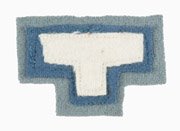
[Heraldry] Rats of Tobruk Association


Rats of Tobruk Association Crest

This is the crest of the Rats of Tobruk Association. It is a group set up by veterans of Tobruk as a means of keeping in contact and raising awareness of the actions of the men of the AIF at Tobruk.

This particular crest is scanned off a window decal that was in my Grandfather's personal items. It's old and never been used. At first I wondered why Grandad wouldn't have put the decal on the back window of his car and then I remembered that when I was young he drove a Toyota Corona. I also remember that he hated the fact that he couldn't afford to drive an Australian built car, as they were more expensive at the time. I never heard him say anything about the Germans commiting war crimes in the Middle East. He did however, never have anything nice to say about the Japanese.

Realising now just what my Grandfather faced at the hands of the Japanese forces in the jungles of New Guinea and Borneo it's no wonder that he just couldn't bring himself to put his Rats of Tobruk decal on his Toyota.

Rats of Tobruk Association window decal from the author's private collection.

[Image] 9th Division troops move From Blue to Red Line at Tobruk

Tobruk, Libya, 8th August, 1941.

9th Division troops move to relieve others in the Red Line.

This image shows unidentified troops of the Australian 9th Division moving on foot from the inner perimeter "Blue Line" to relieve others in positions in the front "Red Line" at Tobruk.

Troops coming off the front lines, where they had often been in close contact with the enemy for weeks, would fall back to take up positions in the inner defensive perimeter known as the "Blue Line". When Tobruk was originally taken from the Italians in January, 1941 by the men of the Australian 6th Division the English command wanted to set up the outer defenses in the area known as the Blue Line. Australian command argued that the outer Red Line should be the one to hold as to do so would place enemy artillery out of range of the vital supply point, Tobruk Harbour. That one decision alone could may well have changed the entire course of the war.


Had defenses been set up at the originally planned Blue Line, Rommel's artillery would have likely captured the city within days. With a deep water harbour secured Rommel could move forward with his plans to rapidly take Egypt and with it, a gateway to the rich Middle Eastern oil fields of Iraq. With unlimited supply of oil relatively close to the planned Eastern Front with Russia the whole shape of the war starts to look different.

What strikes me about this image of the Libyan desert is that fact that the landscape, if viewed through a red filter, reminds me of footage I've seen of the surface of Mars. Weird I know but those rock formations are like nothing I've seen on this planet.

image 041777 Australian War Memorial.

[Image] On leave in Palestine, 1941.


NX17811 Pvt L.J McCarthy
2/17th Battalion
Palestine, 1941.

Today a parcel from my mother arrived that contained all the photos my Grandfather took from his time in active service with the 2/17th Battalion. This one is a classic photo postcard that I've scanned. On the back in my Grandfather's handwriting is the following;

"Tell-Aviv 1941. Les McCarthy. D Coy."

What I also realised when looking through the photos was that one of them stood out like I'd seen it before. It was of a bunch of diggers skylarking at Alamein, one of them wearing a German helmet. Try as I might I just couldn't think where I'd seen it before. I was certain it wasn't on the internet, but rather in a book.

I went and made a cup of coffee and read through the names of the soldiers on the back of the photo and one name stood out.

Jack Barber.

Then it hit me. I had borrowed his book "The War, The Whores, The Afrika Korps" from my local library about 18 months ago and enjoyed it alot. What I didn't know at the time is that alot of these stories in the book concerned his mates on leave. My grandfather was one of his mates. I now have photos of my Grandfather on leave with Jack Barber.

Oh shit. I hope my mum doesn't read that book.

image from the author's personal collection.