Sunday, August 24, 2008
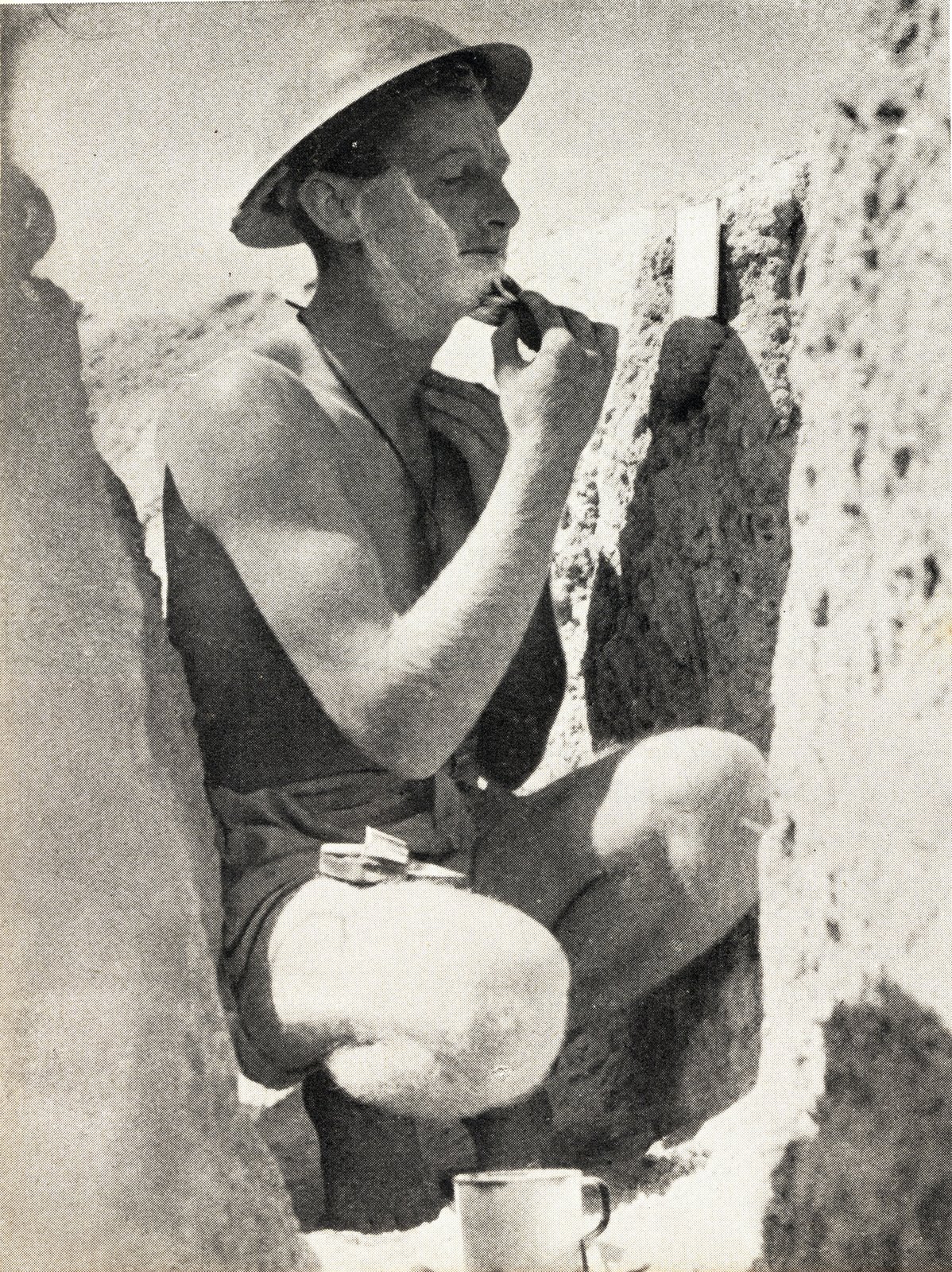
[Image] A rare wash at Tobruk
A rare chance to wash some clothes.
VX33235 Gunner J.W. Croft of the 2/3rd Light Anti-Aircraft Regiment has saved enough of his litre a day water ration to give some basic kit a wash. Gunner Croft hangs his washing to dry on a low slung washing line for a very good reason.
With the flat terrain at Tobruk, anything standing higher than three feet of the ground would draw artillery fire as being unnatural, and therefore enemy. For most men at Tobruk though, a wash in the ocean would be the closest they got to clean clothes.
One Digger recalled that for the entire duration of the siege he only once got a chance to wash, and that was a brief one hour trip to the beach. He also stated that he didn't brush his teeth for six months as it was a waste of precious water that could be drunk instead.
image p01260.012 Australian War Memorial.
Labels:
[1941],
[2/3rd Light AA Regiment],
[Tobruk],
[Water]
[Image] A Lucky Escape at Alamein
One Digger and a lucky escape.
This unidentified Digger of the 9th Division was wounded in both arms in the Second Battle of Alamein and captured by the Germans where he was transported, as a prisoner of war, to a German Dressing Station.
His wounds were treated by a German Medical Officer and when recovering the Dressing Station was captured by British Infantry where the Digger was released and returned to his Battalion. Here he is seen enjoying a smoke while catching up with excited mates.
image 042076 Australian War Memorial.
[Memorial] Australian War Memorial, Tobruk
16th October, 1941. Tobruk, Libya.
The unveiling of the Australian War Memorial.
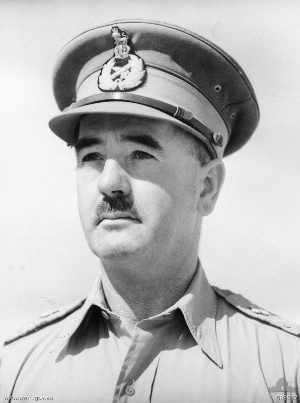
This photograph was taken at the official ceremony to commemorate the unveiling of the tablet on the Australian War Memorial at the Tobruk War Cemetery. The memorial, built entirely by sappers of the Royal Australian Engineers, included a marble tablet inlaid at the base of the memorial.
The inscription reads;
"Here is hallowed ground, for here lie those that died for their country".
Major General Leslie Morshead officiated the official dedication of the war memorial to honour the Australian fallen of the Tobruk campaign. It would be some years before Maj. Gen. Morshead was to return to this site but return he did to honour his Rats of Tobruk.
image 020988 Australian War Memorial.
[Slang] Meet the Baitlayer
The baitlayer prepares his bait.
In another amusing example of Australian slang, the cooks of a battalion were referred to as "baitlayers". This derogatory term was a cheeky reference to the food being poisonous much like a bait for a wild animal.
In this picture the baitlayer is NX34516 Sapper Thomas M. O'Connor of the 2/4th Field Park Company, Royal Australian Engineers who has a reputation amongst the 9th Division as supposedly having 1001 recipies for bully beef. In this case he makes bully pancakes, which the men report as 99% pancake and 1% bully beef.
image 013357 Australian War Memorial.
[Image] The P.M. and the Private.
The Hon. Sir Winston Churchill.
The Prime Minister of England, Sir Winston Churchill, visits the 9th Division forward lines at Alamein. Dressed in Suit, Tie and with Pith Helmet, Mr Churchill uses a horsehair fly swatter to keep the insects at bay. He smokes one of his trademark cigars whilst he is escorted by Major General L.J. Morshead, GOC 9th Australian Division.
SX13319 Pvt. Stanley Collins
2/23rd Infantry Battalion.
When touring the front lines Mr Churchill stopped to speak with Pvt. Collins of Adelaide. What happened next ensured that Pvt. Collins was the most famous man in the 9th Division for a day. He bummed a cigar off the Prime Minister of England.

When later asked by curious mates if he intended to smoke it, Pvt. Collins joked that he was going to take it home have it sealed in glass and would then pass it down as a family heirloom. Pvt. Collins survived the war, discharging in September, 1946 as Staff Sergeant Collins. It is not currently known if he did indeed take the cigar home with him in early 1943.
images 024760, 013354 & 013355 Australian War Memorial.
Labels:
[1942],
[2/23rd],
[9th Div],
[Alamein],
[Anecdote],
[Humour],
[Morshead],
[Winston Churchill]
Thursday, August 21, 2008
[Quote] Lt Gen Erwin Rommel
Lt General Erwin Rommel
GOC Deutsches Afrika Korps
Rommel, never one to hold back with his thoughts, when asked his opinion on the Australian 9th Division opposing him in Tobruk had this to say;
“The toughest but least disciplined troops in North Africa".
image p01112.001 Australian War Memorial.
[Image] Tobruk's Anti Tank Ditch
The Red Line's Anti-Tank Ditch.
QX6167 Lieutenant William Spencer Beaney of the 9th Division Signals examines a stretch of the anti-tank ditch in the forward lines of the 2/48th Battalion positions. This ditch was originally constructed by the Italians in the 1930's but was never entirely completed.
Some sections of the ditch were over 15 feet deep yet other parts the ditch was as shallow as a couple of feet. The Australians completed what work they could with limited manpower and tools. The fact that the ditch was in the forward Red Line meant that it was also within range of the enemy. If any work was done on the ditch it was likely done at night under cover of darkness and out of the heat of the day.
This photo is great for not only the view of the ditch but the cross section of the wall of the ditch gives a great indication of what the land was like. Hard rock is visible all the way to the bottom of the ditch and this shows that digging anything in Tobruk was a hard slow process. I also love the vast flatness of the landscape here. You can see why strategic points like Hill 209 were so important to the outcome of the battles there.
image 020094 Australian War Memorial.
Labels:
[1941],
[2/48th],
[9th Div Signals],
[Red Line],
[Tobruk]
Wednesday, August 20, 2008
[Image] 9th Division scroungers at work
Scrounging from a German Tank.
These two unidentified members of the 9th Division go over a disabled German Panzer Kampfwagen Mk III for anything of value to use against the Axis forces.
Whilst this tank looks relatively intact the telltale dark scoring around the open turret hatch suggests that there will be little of use found inside this tank as it appears to have burnt from the inside. A fire of this magnitude usually meant that the tank took a direct hit from a large calibre anti tank gun. While there is no visible point of entry it is most likely the entry point is on the other side of the tank out of view. The fact that the tracks appear intact also suggests that the tank took a direct hit.
That being said it doesn't look like this is going to deter the Digger on the left who appears to be attempting to move the forward mounted machine gun. This wouldn't be the first German machine gun (likely an MG34) that was taken from a disabled Panzer and put back into service against their former owners by the 9th Division.
image E014741 Imperial War Museum.
Labels:
[1942],
[9th Div],
[MG34],
[Panzer Mk III],
[Scrounging],
[Tank],
[Tel El Eisa],
[Wreckage]
[Memorial] Alamein 9th Division Memorial

22nd December, 2006. El Alamein, Egypt.
The 9th Division Memorial.
This is a modern photo of the 9th Division Memorial at Alamein. The site of the major battle's of 1942 has now been built upon, as evidenced by the buildings in the background. A 5 star hotel now stands on the site of the 2/17th's front line positions during the 2nd Battle of Alamein.
image by Acad Ronin from Wikipedia Commons. Click on the image for a high resolution shot.
Labels:
[2/17th],
[9th Div],
[Alamein],
[Memorial],
[Modern Image]
Subscribe to:
Posts (Atom)