Monday, September 1, 2008

[Image] Tommy got you covered

1st September, 1941. Tobruk, Libya.

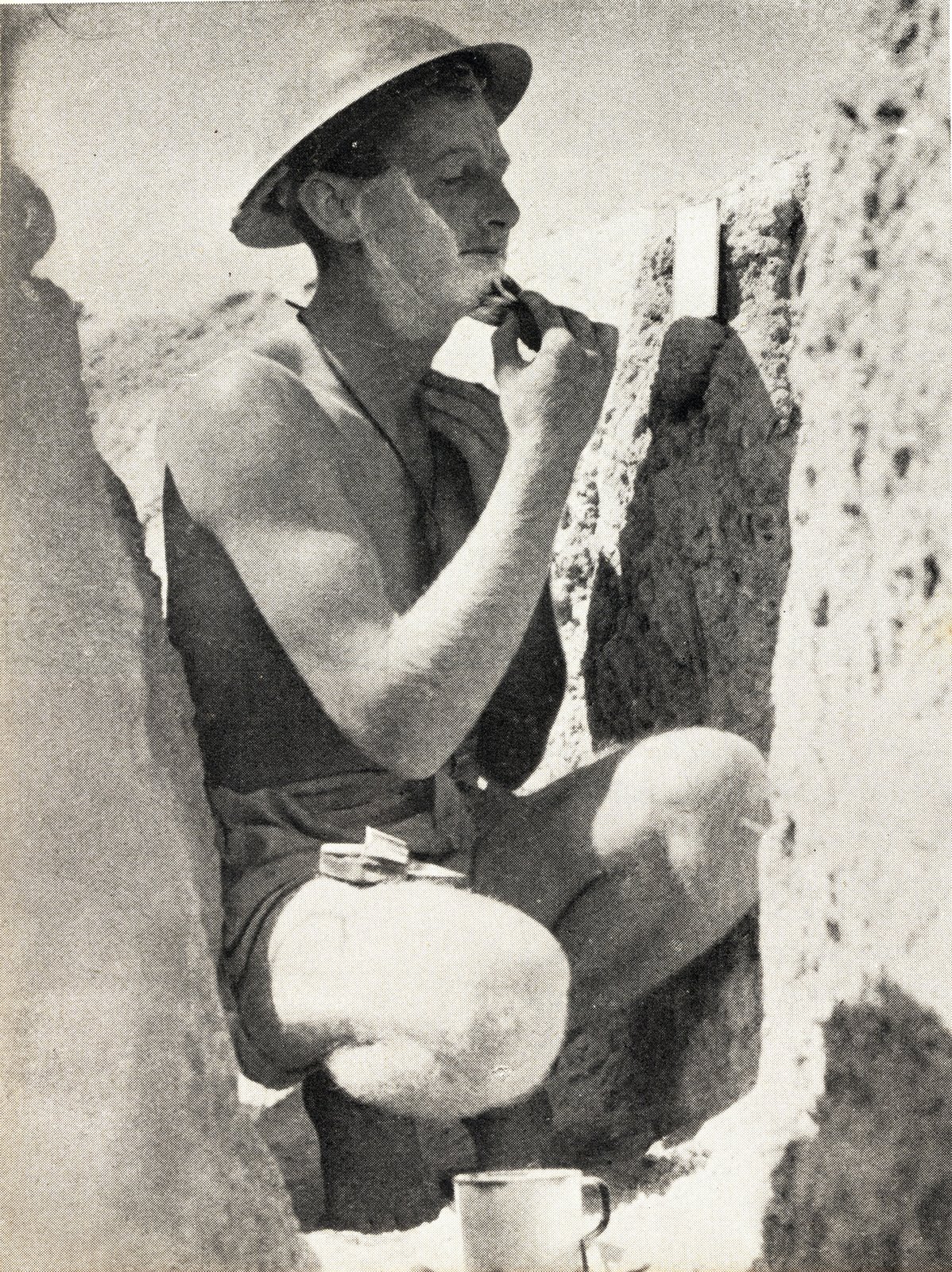
VX31704 Cpl. Warwick Brownrigg & his Thompson.

VX31704 Cpl. W. Brownrigg aims his American made Thompson sub machine gun out a firing slot in the sandbag defences of his position in the Red Line of Tobruk's outer perimeter.

Cpl. Brownrigg, of the 2/23rd Infantry Battalion out of Victoria, featured in a number of photos taken at the time by members of the Military History and Information Unit. In this one he has a rare Tommy Gun with a larger 50 round drum magazine inserted. It also has the fore grip fitted, which with the added weight of the larger magazine made it a necessity for semi-accurate firing.

Cpl. Brownrigg is listed as having been discharged from the Army on 22nd October, 1942. As his service record has not been digitised by the National Archives I am unable to say for certain why. I suspect that his discharge date being so close to the date of the Second Battle of El Alamein that he may have been so severely wounded that he was not expected to be able to return to service and thus discharged. At this stage this is nothing more than an educated guess.

image 020503 Australian War Memorial.

[Image] 25 Pounder at the Australian War Memorial

August, 2008. Australian War Memorial

The 25 Pounder Heavy Field Gun.

A British 25 Pounder Heavy Artillery piece is as returned from service with the 9th Division in the Western Desert Campaign. This actual gun was used during the Battle of El Alamein in the attack that stopped Rommel's final drive across North Africa and is on public display at the Australian War Memorial at Canberra, Australia.

It sits on a heavy steel base plate that acts as a means with which to anchor and turn the gun on uneven ground, like the sand or rock of the Western Desert. It fires the standard commonwealth High Explosive charge but was also capable of firing Armour Piercing, Chemical, Smoke and Flare rounds. This gun is said by many to be the best artillery piece of the Second World War, though there are just as many supporters of the German 88mm.

The 25 Pounder was the standard artillery piece of both the Royal Australian Artillery as well as the Royal Horse Artillery, the British Artillery Regiment, that aided the Australian Infantry with the defence of Tobruk during the siege by the Afrika Korps in 1941.

Several of these guns, along with countless crates of ammunition, were captured by the Germans at Mersa Matruh in Rommel's rapid advance towards Alexandria in 1942. These same guns were turned upon the 2/48th Infantry Battalion during the Battle of El Alamein with devastating effect. The 2/48th retook the guns within a short period of time and again set them upon the fleeing Germans.

All accounts from Tobruk that I have read all say that without the support of the Royal Horse Artillery the Siege of Tobruk would have been over very quickly. Tobruk was the perfect example of Australian Infantry and British Cavalry and Artillery working as one cohesive unit.

image courtesy of Robert Snewin. Used with permission.

This post is a direct reponse to the question asked by Douglas Chan who wanted to know what were the Royal Horse Artillery guns used during the Siege of Tobruk. I hope this helps Douglas. Good luck with your project!

[Image] German Vanity at Alamein

September, 1942. El Alamein, Egypt.

The Swastika flags bound for conquered Alexandria.

These unidentified men of the Australian 9th Division enjoy hunting for German souvenirs amongst the vehicles that they destroyed in a recent advance. It was said that Rommel was so confident on taking Alexandria with his last push that he was ordered by High Command in Berlin to ensure that all vehicles carried adequate supplies of swastika flags so that the victorious Afrika Korps could enter Alexandria under full colours.

In reality they made really cool souvenirs for Aussies to take home to show their friends and family alike. With the ample amount of them carried there were very many less disappointed Diggers after Alamein than before.

images 042008 and 042009 Australian War Memorial.

[Image] Anzac Day 2008, Tobruk, Libya.

April 25th, 2008, Tobruk, Libya.

An impromptu dawn service at Tobruk.

On a cold, windy Libyan April morning a small group of expat Australians and a few English gather at the Australian Memorial at the Tobruk War Cemetery. With no official consular representation or organised service these dedicated few gathered together to say a few words in memorial to the Rats of Tobruk that never came home to taste the glory of a proud nation.

I find it extremely sad that there was no official Australian Government representative at Tobruk on Anzac Day. It seems that it is up to a few of us to remind the world of the extreme sacrifice undertaken by them on our behalf.

It is my sincere hope to be there at Tobruk on Anzac Day, 2011 for the 70th Anniversary memorial. If the Australian government wont see fit to appropriately honour these men then I will do it myself, by any means possible.

image news.ninemsn.com.au

[Image] 20th Brigade Colour Patches

2/13th Infantry Battalion
New South Wales.

2/15th Infantry Battalion
Queensland.

2/17th Infantry Battalion
New South Wales.

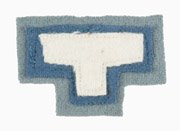
These are the felt colour patches worn by the members of the 20th Brigade of the 9th Australian Division. The felt colour patch is worn on the upper outer sleeve of the tunic on both the left and right arms. They differ from other patches that were worn by other members of the AIF in the Second World War in that they are shaped like the letter 'T' whereas members of the 6th, 7th (except the 18th Brigade) and 8th Divisions wore a patch in the shape of a diamond separated into a top half colour and a bottom half colour.

The significance of the colour patches as worn by the 9th Division and members of the 18th Brigade of the 7th Division is that the shape has been varied from the AIF standard diamond to that of the letter 'T' in tribute to the Battalion's involvement in the defence of Tobruk. It was a badge that the Rat's wore with pride. When on leave everyone knew they were the one's who stopped Rommel in his tracks for so long.

The grey outline signifies the 9th Australian Division, the green border belongs to the 20th Brigade and the 'T' shape is in the individual battalion colours, the 2/13th was black, the 2/15th was purple and the 2/17th was white.

The changing of the colour patch's shapes, in recognition of the men involved in the Siege of Tobruk, has only ever been done this once in the entire history of the AIF.

This is one of the best indications of the significance of the action that the 9th Division was involved in at Tobruk was not lost on the Army. The Army changed nothing in recognition of deeds performed during World War One. This to me is one of the highest honours that the Army ever placed on the 9th Division.

colour patch images General Collection Australian War Memorial.

Friday, August 29, 2008

[Quote] Lt. Tas Gill, 2/48th Battalion

1st June, 1941. Tobruk, Libya.

Lt. Tas Gill, 2/48th Battalion.

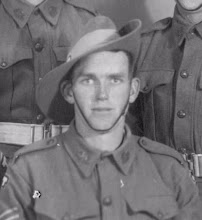
Lt. Tas Gill of the 2/48th Battalion pictured above at the extreme right with mates in Palestine in 1941 had this to say about conditions at Tobruk;

"Today has been distressingly hot, about 115 I should think. Consider your plight for a moment - living in shallow holes in rocky ground, not a tree with[in] hundreds of miles, no shade except what we make with bits of wood and so on, none of the luxuries of life such as eats and drinks, and nowhere to go and no respite."

For those of you who like me live in a metric world, 115 degrees Fahrenheit is 46.1 degrees Celsius. That is hot.

image p00237.042 Australian War Memorial.
Wednesday, August 27, 2008

[Image] The Price of Victory

27th January, 1943. El Alamein, Egypt.

The wrecks of allied tanks from Alamein.

These allied tanks, knocked out by Axis forces during the Battle of El Alamein, await transport to allied workshops for repair and refit. With a desperate need for all armoured vehicles to be serviceable and with production of new units unable to meet demand, it was a logical choice to repair these tanks.

In the foreground is the US built M4 Sherman Medium Tank. This was the tank that broke the Africa Korps. Supplied under the Lend-Lease Act where America supplied war materials to the Allies in return for military base rights in allied colonies around the world. The agreement also called for the return or destruction of all war materials after the war but with nearly a billion pounds of equipment enroute when the war ended which was vitally needed by the British it was decided by the Americans to sell it at 10 cents in the dollar.

The Americans allowed the British to pay off the money owed in 50 annual installments even allowing the British to defer payments when foreign exchange rates were not favourable to them. In essence it was a deal too good to be true. Over the years the British Government elected to defer payments on 6 occasions. The final payment was made to the US Government in 2006.

image 014269 Australian War Memorial.
[Image] 9th Div Salvage Unit under fire

5th October, 1942. El Alamein, Egypt.

9th Div Salvage Unit under fire.

Being shot at is all in a days work for members of the 9th Division Salvage Unit in the desert at Alamein. These men were working to recover a disabled Bren Carrier in the forward line areas when a German shell landed dangerously close.

Whilst some men have wisely gone to ground, some merely crouch. The Salvage Unit often worked extremely close to enemy lines and were often shelled or fired upon whilst conducting their vital work. With limited access to rapid resupply of lost heavy vehicles it was often in the best interests of the 9th Division to salvage what they could and repair it for further use. Anything that could be salvaged was, even enemy equipment and hardware was pressed into service against the Axis forces at Alamein.

image 013351 Australian War Memorial.
[Image] Death of a Valentine

17th July, 1942. El Alamein, Egypt.

German shrapnel defeats the Allied Valentine Tank.

In a perfect example of why the allies needed heavier tank armour in the Western Desert this Valentine II Infantry tank has been disabled by shrapnel from German shelling. If shrapnel can be so devastating against an armoured target like this, it is horrifying to think of it's effect on infantry in the open ground of the Western Desert. This is a major reason casualties were so high at Alamein.

image 024552 Australian War Memorial.