Saturday, September 6, 2008

[Image] The Water Rat of Tobruk

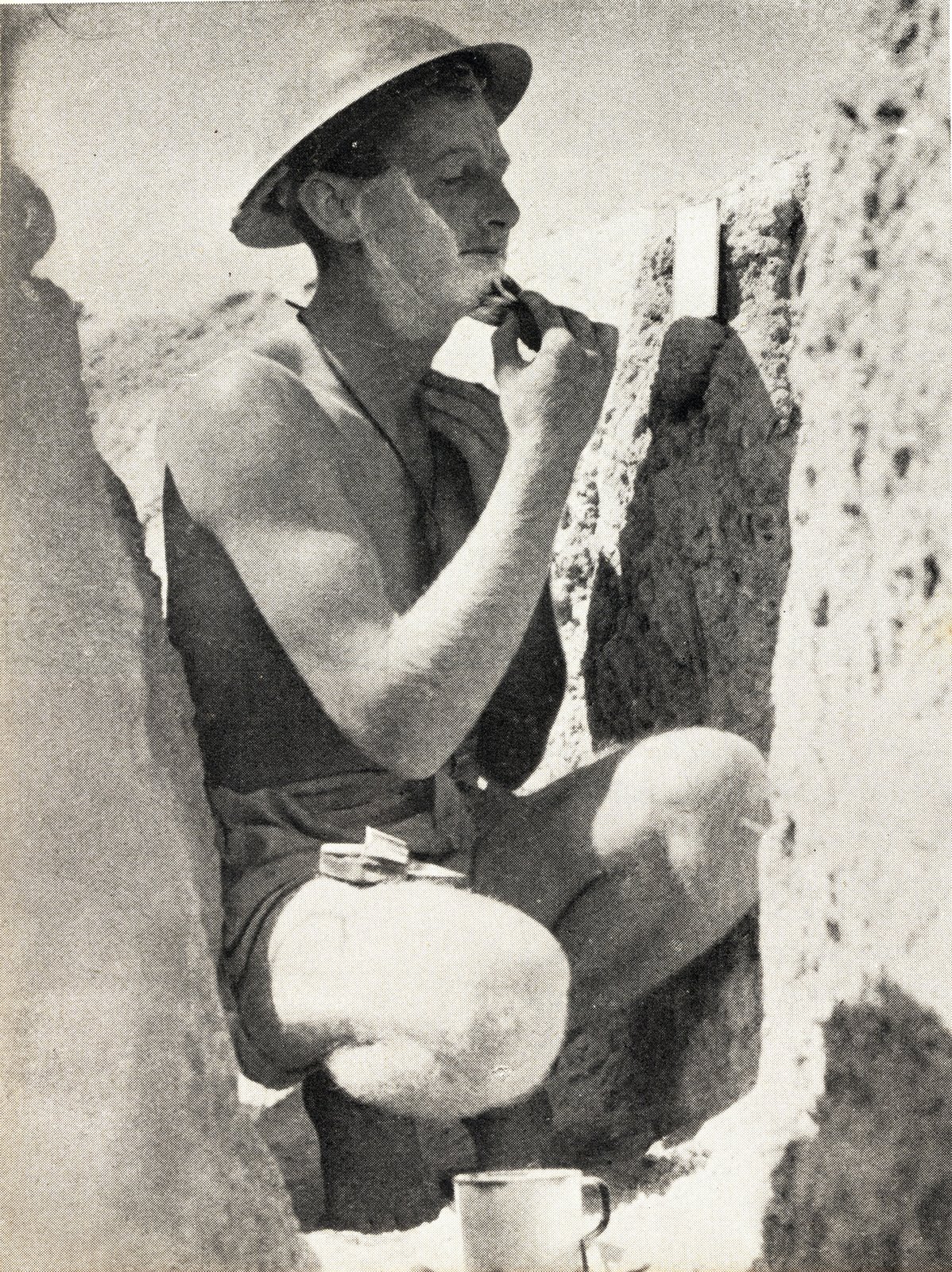
25th September, 1941. Tobruk, Libya.

Gelignite fishing in the harbour.

This soldier of the 9th Division, identified only as Bill Woodhouse of Wynnum, Queensland, is fed up with the constant rations of bully beef and biscuits and looks to supplement his and his mates rations with a few fish fresh from the Mediterranean caught by throwing sticks of Gelignite into the harbour. The ensuing explosion causing a shock wave in the water that kills the fish allowing them to rise to the surface to be collected by the hungry Diggers.

The fish provided the men with much needed variety of fresh protein that the army rations lacked. It was also a much needed stress relief to have a swim in the ocean.

images 020635 and 020636 Australian War Memorial.

Catch of the day, Tobruk style.

[Image] RAAF foils a Red Line Raid

1941. Tobruk, Libya.

Red Line positions get strafed.

A German Luftwaffe Messerschmitt BF109 Fighter strafes 9th Division front line posts with it's three mounted machine guns raising up clouds of dust and sand as the bullets impact the ground.

Little did this pilot know that his actions were noticed by one of the few Australian RAAF pilots who were still operational in the area who dropped in on him and shot him from the sky to the cheers and applause of the infantry in the Red Line.

I think the above photo is amazing in that it is evidence of the low altitude that the German pilots would drop to in order to have a final parting shot at the entrenched infantry. I have read accounts from members of the 2/17th Infantry Battalion that stated that they were often strafed by fast low flying German's at altitudes as low as 100 feet (approximately 30 metres for the metrically inclined).

They would often have a last parting shot at the infantry after supporting dive bombers on their attack run over the harbour and then follow the El Adem road to the safety of the escarpment and the German lines. If damaged these planes would make an all out last ditch effort to put down beyond the Red Line. Some made it, some didn't. Often the same pilots would strafe the same positions at the same time each day and would make 4 or 5 passes then tip their wings and wave at their intended targets before escaping for another try.

This one was unfortunately caught short by a rare allied fighter. The Luftwaffe certainly had unprecedented air superiority in the Western Desert in 1941. One wonders with 10 German fighters for ever 1 Allied one (at best) if some Luftwaffe pilots would be a little overconfident about their chances.


One less Messerschmitt to worry about.

images 010852 and 010843 Australian War Memorial.

[Image] The long walk to the cage

April, 1941. Tobruk, Libya.

2/48th Captures 70 Italian POW's.

A lone Digger of the 2/48th Infantry Battalion leads a column of Italian POW's on the long walk back from the front lines to the Prisoner of War cage. This was a march of approximately 10 kilometres. With shouldered Lee-Enfield .303 and fixed bayonet he leads the prisoners past the HQ of the 26th Brigade.

It was because of the Italian's general reluctance to fight, and the fact that they felt they would be treated better by the Australians than the Germans, that they willingly surrendered in large numbers. Many captured Italian soldiers possessed a white silk handkerchief and were not afraid to use it. Italian soldiers would often withstand sustained small arms fire from a distance but would crack at the sight of the fixed bayonet up close. Even many of the Afrika Korps chose to spend the rest of the war as a POW than fall victim to an Aussie bayonet. Making this choice is not an act of cowardice.

Many of these Italian prisoners were sent back to Australia and sent to work on farms in rural areas, often later immigrating back after the war to purchase their own farms.

image p02242.018 Australian War Memorial.

Friday, September 5, 2008

[Image] One less Italian bomber over Tobruk

June, 1941. Tobruk, Libya.

A fiery end to an Italian air raid.

This Italian bomber met with a fiery end after attempting to bomb Australian positions at Tobruk. Relatively structurally intact, this suggests that the plane managed to make a forced landing but was consumed by fire whilst grounded.

Whether destroyed by fire, or Australian scroungers, there is very little left that is salvageable on this plane. Note the completely featureless landscape behind the wreck.

Image 020071 Australian War Memorial.

[Image] Wrong Place, Wrong Time.

19th October, 1942. Tel el Eisa, Egypt.

Wreckage of German supply convoy.

During the last intense days of fighting at Tel el Eisa this German supply convoy arrived with much needed food, water and ammunition. Whilst attempting to deliver the supplies to their intended destination the course of the battle changed and they found themselves behind 8th Army lines. For some hours the battle raged back and forth with ownership of the supplies changing hands twice between British and German troops with the Germans eventually retaining their prize.

Being frantically directed away from the battle to the new supply delivery point by German Intelligence the convoy arrived to find that they had been mistakenly directed into the 9th Division's front lines.

The Germans went hungry that night.

image 013463 Australian War Memorial.

[Image] A Rat in a Hole

August, 1941. Tobruk, Libya.

A Rat in a Red Line hole.

Pvt. J. Collins escapes from German shelling in his doover. Pvt. Collins has been able to scrounge wood and metal to brace the walls and roof of his hole in the ground. Men spent incredible lengths of time laying about in holes just like these. It was not uncommon to have to lie in your slit trench all day in blistering heat with little water, having to relieve yourself in a old fruit tin, any movement above the surface would draw the fire of the Germans.

Pvt. Collins has letters from home in the rafters of his shelter. This is obviously a more long term doover, as one would construct during an extended period in the front lines. This photo was taken during a German artillery attack on Red Line positions. This would keep the Diggers underground for extended periods in cramped, hot and dusty conditions. Depending on the time of the shelling men in the Red Line ran the risk of missing out on their one hot meal a day if the rations trucks were attacked.

image 009513 Australian War Memorial.

I have been unable to positively identify Pvt. J Collins as there were 217 men with that name that served in the Army during WW2. If time permits in the future I will attempt to make a positive identification.

Tuesday, September 2, 2008

[Image] "Soldato Australiano Sconosciuto"

December, 1941. Tobruk, Libya.

"Unknown Australian Soldier".

This moving shot, by legendary war photographer Damien Parer, was taken at an Italian War Cemetery just outside of Tobruk. Amongst the Italian graves Parer found a sole grave with a simple yet dignified wooden cross with the inscription "soldato australiano sconosciuto".

The Western Desert is still disclosing secrets from World War Two. In April, 2008, renowned Western Desert Battlefield tour guide Steve Hamilton located 30 graves from members of the Afrika Korps that the German government has admitted to "not knowing about".

image 010989 Australian War Memorial. Negative by Damien Parer.

Monday, September 1, 2008

[Image] Bored Engineers are trouble

22nd September, 1941. Tobruk, Libya.

9th Division Engineers improvise a flamethrower.

This Sapper from the 9th Division's Royal Australian Engineers demonstrates a method of improvised flame throwing. In a used 44 Gallon drum he mixes a potion of 60% Benzol and 40% Petrol. Into the mix was thrown a handful of metal shavings.

When ignited by remote device this drum exploded with an immense curtain of liquid flame that would be devastating to exposed infantry. I particularly like the silhouette of the slouch hat in the explosion in the bottom photo.

images 020665 and 020666 Australian War Memorial.


[Image] The barbed wire clothesline

25th September, 1941. Tobruk, Libya.

A rare opportunity to get clean.

For these men of the 9th Division a rare trip to the incredible white beaches of the Mediterranean is not only leisure, but necessary for bathing. With strict water rationing in effect a soldier's water ration was best used for drinking leaving little for personal hygiene.

The crystal clear salt water of the Mediterranean not only refreshed the troops but doubled as a form of antiseptic, with the salt water immersion aiding in the healing of wounds and desert sores. It was also a welcomed opportunity to wash your very soiled clothes.

It was an unwritten law of the Siege of Tobruk that troops resting at the beaches were not to be fired upon. It was not uncommon for a group of Diggers taking a rest spell on a beach at Tobruk to see Afrika Korp's troops swimming carefree a few miles down the beach.

image 020618 Australian War Memorial.