Tuesday, August 5, 2008

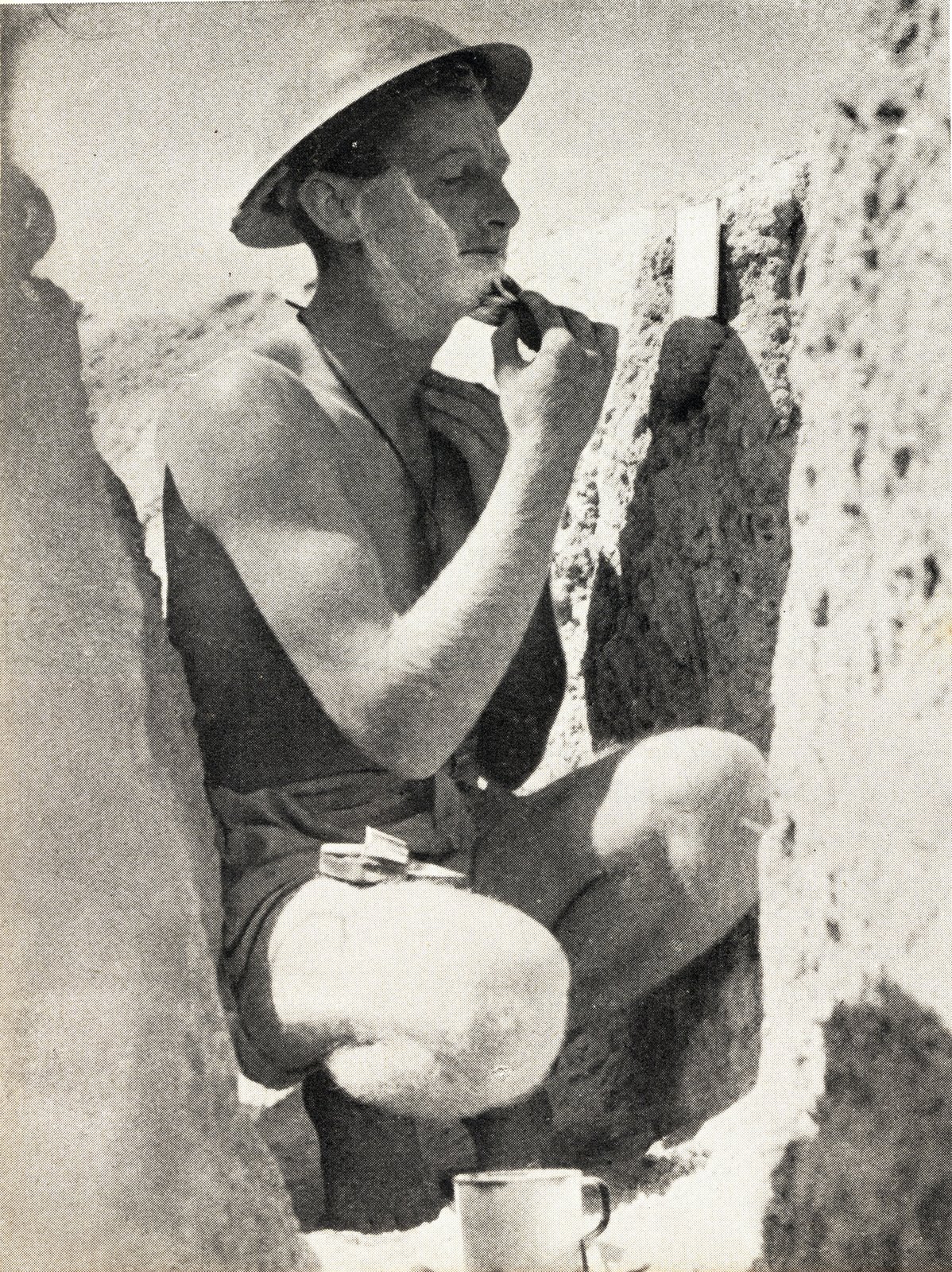
[Image] "...a brave, dashing and resourceful soldier." - Morshead.


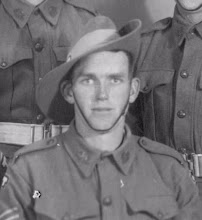
VX27678 Pvt. Morris J. O'Connell M.M.
2/23rd Infantry Battalion.

1st January, 1942, Palestine.

At the time that this photo was taken on New Year's Day in 1942, Pvt. Morris O'Connell was taking a break from competing in the Hockey tournament of the 9th Division Sporting Day.

Pvt. O'Connell was awarded the Military Medal (MM) for bravery in the field at Tobruk. The final sentence on the citation for the award, written by Morshead himself, called Pvt. O'Connell a "...brave, dashing and resourceful soldier". Further investigations into Pvt. O'Connell reveal a soldier with a few more disciplinary issues than the citation would have you believe, but in true Australian fashion some of the bravest soldiers in battle are often the most defiant outside of it. In any case you judge for yourself.

Pvt. O'Connell's citation for the Military Medal reads;

"The Commander-in-Chief, Middle East has approved the immediate award of the Military Medal to VX27678 Pvt. M.J. O'Connell of the 2/23rd Inf. AIF."

"Pvt. O'Connell was a member of a party that carried out a raid successfully against enemy forces of unknown strength west of Tobruk on April 22nd, 1941. He took part in the capture of the first enemy post and then dashed ahead on his own."

"Jumping into a sangar he threw a Mills Bomb (hand grenade), killed several of the enemy and captured an officer and seven other ranks."

"During the withdrawal of the patrol he escorted his prisoners back to the perimeter, a distance of 3,000 yards, in the face of intensive artillery, mortar and machine gun fire. A brave, dashing and resourceful soldier".

Looking at Pvt. O'Connell's service record at the National Archive's website one can see a few disciplinary issues. Before embarking to the Middle East, Pvt. O'Connell faced a Board of Enquiry when the Army truck that he was driving crashed into a private bus when he was on leave and not supposed to be in control of an Army vehicle. He sustained a rather bruised buttock and was fined.

In Tobruk in March of 1941, a mere 12 weeks before his MM, Pvt O'Connell was charged with two offenses.
  1. "Failing to appear at a place of parade appointed by a commanding officer" for which he was fined 10 shillings and 7 days pay.
  2. "Conduct prejudicial to a Commanding Officer's Military Discipline" for which this offence cost him a fine of 20 shillings.

In spite of his reported disciplinary issues Pvt. O'Connell showed all of his commanding officers that they were wrong about him and proved himself a soldier when it mattered most, when with his mates and under fire.

It was whilst Pvt. O'Connell MM was with his mates and under fire at Tel el Eisa on the night of 22nd July, 1942 that he was killed in action. He is buried at the El Alamein War Cemetery. He is memorialised on the Roll of Honour here;

http://www.awm.gov.au/roh/person.asp?p=147-17814

At the time of his death, like too many of the men killed at Alamein, Pvt. Morris Joseph O'Connell was 23 years old.

image 022764 Australian War Memorial

Pvt. O'Connell's entire digitised service record can be viewed at the National Archives Website. See the link in the sidebar on the right under "Research Links".

[Image] 2/13th Mortar support at Tel el Eisa

Tel el Eisa, Egypt, 1st August, 1942.

A two pounder gets sent on its way.

NX16706 Pvt. Leslie S. Myers of the 2/13th Infantry battalion drops another two pound mortar shell into his launcher in support of the 9th Division advance at Tel el Eisa (The Hill of Jesus).

You can see what appear to be vehicles of some description on the horizon. Whatever they are they are above ground level and in this case a very valid target. You can see also a plume of smoke in the distance in the direction of fire of Pvt. Myers’ mortar. There also appears to be another dug in position several hundred yards in front of Pvt. Myers’ position. As he is firing live rounds in that direction my guess is that’s where Gerry calls home.

This photo taken not far above ground level can give you an appreciation of just how dangerous it would be to be caught in the open of the desert during a shell attack. Your only hope would appear to be to keep moving forward.

Pvt. Myers seems to have quite a bit about the top of his weapons pit. A Lee-Enfield .303 rests on the sandbags behind him as too does his cigarettes and matches. He looks like he has more mortar ammo to his right within easy reach and he is wearing the commonwealth Tin Hat with hessian cover.

To his left is what looks like a binoculars case. Makes sense that the guy with the mortar would have field glasses to spot targets with and to accurately gauge the range on enemy positions. Empty tins of bully beef can be seen in the foreground of the photo below. In the bottom photo Pvt. Myers looks like he has some kind of rangefinder or telescope.


images 0941967 and 041968 Australian War Memorial.

Saturday, August 2, 2008

[Image] Tobruk (c.2002 in colour)

The lone Fig Tree still stands north of the Derna Road

During the Siege of Tobruk, the 9th Division operated a Regimental Aid Post (RAP) in a cave underneath the lone fig tree just north of the Derna Road and behind the Red Line. The cave, like the fig tree is still there.


Weapons pits of the Red Line still virtually untouched.

Only time itself seems to have been in these weapon pits since the departure of the allied forces from Tobruk. There is even still, in 2002, evidence of spent shell casings and magazines found in these trenches.

The Harbour as it was in 2002.

And this is what the whole thing was all about. Whoever controlled the deep water harbour in Tobruk, the only deep water port between Egypt and Tripoli, could rapidly move troops and supplies via sea rather than transport them up to 1,200 miles over the harsh desert.

Holding Tobruk for the time that they did meant that the Australian's and English troops there delayed the Battle of El Alamein until a time when the Allies were adequately reinforced and supplied. It seems weird to see the harbour in colour and without the wrecks of so many ships in it.

images from Galen R. Frysinger, Wisconsin, USA. http://www.galenfrysinger.com/tobruk_libya.htm

[Image] Meet the 9th's latest Reo's


Nuseirat, Palestine, October 9th, 1942.

The first mess parade of the 2/48th's latest.

The latest "Reo's", Army slang for reinforcements, arrive at their staging camp at Palestine. These men have arrived and are queuing up for their first mess parade in their new temporary home.

Considering that this photo was taken a mere three weeks before the 2nd Battle of El Alamein in late October one wonders how many of the men in the above photo met their ends on that bloody battlefield like so many of their mates.

The 9th Division suffered disproportionately higher casualties as a result of the dangerous assault that they were tasked with undertaking against the might of Rommel's Panzer Divisions. Large numbers of troops on both sides were killed and wounded by the blanket shelling that both sides launched at each other mercilessly for a period of nearly two weeks in late October to early November, 1942.

image 025099 Australian War Memorial.

[Image] 2/43rd Bren Gunner in Syria

Homs, Syria, 18th June, 1942.

Bren Gun Training for Alamein.

SX11192 Pvt. Frank T. Hardy poses with his Bren Light Machine Gun, in a prone position with the barrel mounted bipod deployed, during training in Syria in June, 1942.

Little would these men know it but in a matter of weeks after this photo was taken they were withdrawn from Syria and rapidly sent to the Western Desert to reinforce Montgomery's 8th Army at the Battle of El Alamein.

Pvt. Hardy is obviously posing for this shot as the Bren gun lacks it's distinctive banana shaped magazine at the top of the gun and is therefore empty and not quite as menacing as he makes it look.

It was training such as this, with the Bren Gun, that allowed WX11519 Pvt. Leslie T. Starcevich V.C. of the 2/43rd to dispose of so many of the enemy in his action that earned him the Victoria Cross in Borneo in 1945. More on Pvt. Starcevich V.C. when this blog moves to the Pacific Campaign in the near future.

image 024411 Australian War Memorial.

[Image] The faces of the 2/32nd at Alamein

El Alamein, Egypt.

Men of the 2/32nd Battalion and their Bren Carrier

Three unidentified members of the 2/32nd Infantry Battalion pose alongside their Bren Gun Carrier at Alamein. They wear three different types of headgear from left to right: slouch hat, woollen beanie and tin hat.

The soldier on the right carries a trophy of war, a German Mauser Kar98 Rifle while the man in the middle wields a machete, a rather unusual choice given the desert location and in all likelihood this was not standard issue equipment for the Western Desert. He also appears to wear some kind of tinted goggles or sunglasses, a rather rare commodity at Alamein.

image p02522.005 Australian War Memorial.

[Image] 2/17th troops try out an Italian flak gun at Alamein

4 Sec, D Coy, 2/17th Infantry Battalion

The Italian Breda Model 35 20mm Anti-Aircraft Gun.

Men of 4 Section, D Coy. have a bit of fun on a captured Italian Breda Model 35 20mm cannon. These flak guns were primarily used in an anti-aircraft capacity however they had some use against soft targets like trucks, cars and infantry.

This photo was taken at Alamein in 1942 by my Grandfather, NX17811 Pvt. L.J. McCarthy of the 2/17th Infantry Battalion. This particular gun was popular amongst troops of the 2/17th for posing on for photos to send home. I have seen a photo of Jack Barber, also of the 2/17th and author of "The War, The Whores and the Afrika Korps", trying out the same gun in the photos within his book.

Click on the image for a high resolution copy.

image from the author's personal collection.

[Image] Explosive End Vol. 3

Egypt, 1942.

A M3 Grant Tank falls victim to the "dreaded 88".

An unidentified Sgt. of the 2/3rd Anti-Tank Regiment of the 9th Division photographed the explosive aftermath of the American built M3 Grant when hit at close range by the German 88mm flak 36 Anti-Aircraft Gun. With absolute certainty the entire crew of this tank would have been killed instantly.

These 88mm Guns struck fear into the allies with their devastating effect and terrorising sound when fired. They were capable of penetrating 100mm of armour at 400 yards. By the looks of the outcome on the more heavily armoured M3 this one was fired upon by an extremely close 88. In the western desert these guns were sometimes dug into the ground to create a fixed position. An example of one of these guns is shown below.


November, 1942, Libya.

A dug in German 88mm Flak 36 Anti-Tank Gun.

Australian troops inspect the much feared German 88mm flak gun. This particular gun was dug in to the sand of the Western Desert to protect the crew from shell fire from allied tanks by creating a much lower profile.

Digging the gun in allowed the crew to fire on a distant allied tank much easier as to raise the arm of the gun up high to fire on a distant target in the flat terrain of the desert meant that you were likely to be more easily targeted with return fire. A smaller profile meant you were a smaller target and therefore, in theory, much harder to hit.

For the crew of this 88, the theory was disproven as when Australian troops arrived to inspect the gun they found the entire crew buried nearby.

images p01393.010 and 040977 Australian War Memorial.

[Image] Panzer Mk III disabled by 9th Division AT Gunners at Alamein


El Alamein, Egypt. August, 1942.

A victim of the Boys Anti-Tank Rifle.

This Panzer Kampfwagen III Medium Tank was taken out of action by Anti-Tank gunners of the 9th Division. The small hole between the second and third wheels from the right is where the disabling shell entered the armour.

image 024856 Australian War Memorial.