Saturday, August 9, 2008

[Image] German shells fall at Alamein

1st November, 1942. El Alamein, Egypt.

German shells burst in 9th Division positions.

Late on the afternoon of the 1st November, 1942, Australian positions at Alamein came under shell fire from German artillery. A shell explodes behind a large 9th Division truck. A lone digger can be seen running for the cover of the dug out in between the two trucks to the right of picture. This explosion is huge when compared to the size of the trucks in the foreground. This is not a barrage to be caught out in the open in.

image 042082 Australian War Memorial.

[Image] The true origins of Beach Cricket


September, 1942. El Alamein, Egypt.

The birth of beach cricket.

Australians have always loved sport and the outdoors. In spite of what beer company marketing gurus will tell you these photos don't lie. Australian troops of the 9th Division invented beach cricket during a spell in the beach area away from the front lines at Alamein in 1942.

Whilst not having the entire regulation kit nor proper grass wicket the troops of the 9th Division did what they do best. They made do with what they had. A bat, ball, stumps and even a set of pads and keeper's gloves were located and a sand wicket established.


"Slips Fieldsman"

"another cracking shot"

images 041992, 041993 and 041994 Australian War Memorial.

[Image] The Vickers of Tel el Eisa

Tel el Eisa, Egypt. July, 1942.

The Vickers Machine Gun at work on German positions.

NX25016 Pvt. Barrie Rymer and NX21498 Pvt. Paul Cullen of the 9th Divisions' Machine Gun Regiment fire their Vickers Machine Gun at German positions. This particular gun crew fired this gun at the German positions for two whole days. The spent cartridges burnt their hands and arms and they even used water from their own personal issue to keep the gun cool so that it would remain in action.

At the time of this action in 1942 the Vickers Machine Gun had been in service with allied forces for 30 years. It was water cooled, which meant it was heavier than air cooled machine guns and relied on a ready supply of water. The reservoir around the gun's barrel held 4.3 metric litres of water which boiled in the jacket around the barrel. This then converted to steam, which ran out a rubber hose at the back of the gun into a metal can to condense where it could be poured back into the jacket.

Whilst impractical in a desert environment the entire closed nature of the cooling system meant that there was no telltale steam emissions from the gun when fired allowing a Vickers crew to keep firing from fixed positions for longer before being given away. The constant need for water was a problem with many crews resorting to measures from using their own personal drinking water to urinating in the jacket. Any spare liquid would be pressed into service to cool a raging Vickers gun in action.

There was an action documented during WW1 at High Wood on 24th August, 1916 where a British Vickers gun regiment was tasked with keeping a large open area 2,000 yards away covered with suppressing fire for a period of 12 hours to ensure that the German infantry didn't form up for a large scale attack. Two entire infantry companies (several hundred men) were allocated to support these 10 guns with water, ammo and spare parts for the duration of the action.

Between them, and over the allotted 12 hour period, these 10 Vickers Guns fired one million rounds at the Germans. Barrels were changed every hour, a process that took a well trained crew two minutes and at the end of firing not one Vickers had broken down. It's easy to see then that the men pictured above could have easily fired for such an extended period.

With this kind of reliability it's no wonder the Vickers was used extensively in the desert by the 9th Division in spite of all it's inherent impracticalities.

image 041953 Australian War Memorial.

WW1 Vickers Gun anecdote source;

"Weapons & War Machines." by Ian V. Hogg & John Batchelor. London: Phoebus, p. 62 (1976).

Thursday, August 7, 2008

[Propaganda] 1941 AIF Recruitment Poster


"Mister, Here's Your Hat!"

This AIF Recruitment poster, as published by the Department of the Army in 1941, was used to entice young men into enlisting in the Army. An attractive young woman hands an Army slouch hat to a prospective recruit.

How many men of the 9th Division were swayed into enlisting by the nameless girl will never be known, however I'm sure there were plenty of Diggers who wished they'd never laid eyes on her before.

In 1941, just like today, sex sells.

image ARTV06443 Australian War Memorial.

[Image] Thirsty work this desert warfare.


Western Desert, Egypt. 1st August, 1942.

Filling water cans at 9th Div HQ.

Fighting in the Western Desert is thirsty work, and none know just how thirsty like these men of 9th Division HQ who are filling water cans from the 500 gallon tanker in the picture.

Every single drop of water needed to be carted across the desert to the armies in the field. Rommel had more of a problem with the huge distance that his supply line had to transverse to get to the battlefields of Egypt. Water was a precious commodity, even more so when some could be spared from drinking for washing body and clothes.

Many Australians chose to drink their water and just rely on the occasional swim in the ocean at Alamein for all their bathing. The veterans of Tobruk were well versed in water rationing and had many novel ways to maximise the usefulness of even the tiniest amount.

image 024690 Australian War Memorial.

[Image] Bren Carriers at Tel el Eisa


Tel el Eisa, Egypt. 1st August, 1942.

Bren Carriers advance in support of 9th Division troops.

These Bren Gun Carriers are photographed at Tel el Eisa in support of an infantry advance by the 9th Division. The lead carrier seems to be mounting a Boys Anti-Tank Rifle in it's forward hardpoint whilst the unmistakable silhouette of the Bren Gun and bipod is visible out of the open topped carrier at the left.

image 041966 Australian War Memorial.

[Image] "Monty" and THAT Slouch Hat.


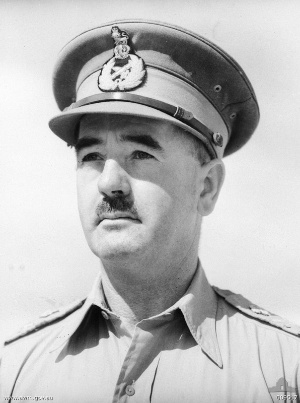
Lieutenant General B.L. Montgomery, CB DSO
Commander of the Eighth British Army
Tel el Eisa, Egypt. 21st August,1942.

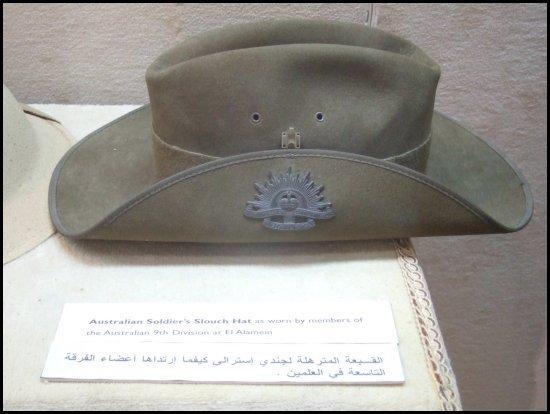
When Lieutenant General Bernard Law Montgomery CB DSO paid the forward positions of the 9th Division at Tel el Eisa a visit on 14th August 1942 he is reported to have requested an Australian slouch hat to wear.

Members of Headquarters, 24th Infantry Brigade quickly found "Monty" his requested hat and from that point forward Montgomery chose to wear the Slouch Hat as a part of his standard field uniform.

In the photo above Montgomery is photographed with a rare smile on his face a week after being presented with the hat. By this time word had spread that the Commander of the British Eighth Army had taken to wearing Dominion head wear as standard dress. This caused a mixed reaction amongst members of the Eighth Army.


Here Montgomery is seen wearing the hat at Tel el Eisa after having toured the forward positions for himself. As he inspected his lines he passed through positions held by different forces under his command. At each opportunity Montgomery collected the hat badges of the units and attached them to his slouch hat. A good collection of them can be seen above.

Reactions to Montgomery's choice of hat varied. Members of the Royal Australian Artillery stated that he looked like a "prize galah", whilst members of the Infantry saw it as an honour that out of all the different nationalities and units under his command that he chose an Australian Slouch Hat. In spite of all the inherent practicalities of such a hat in the Western Desert it was a real morale boost for members of the 9th Division to see Monty in their hat.

Others however were not convinced as to the suitability of their General wearing this hat and members of the Royal Tank Regiment saw to it that they presented Monty with a black beret in the hope that he would restore order and wear appropriate head dress. Someone must have had a quiet word to the General as he gave up his adored slouch hat and wore the Royal Tank Regiment's beret for the rest of the Western Desert campaign.

Lieutenant General Bernard Law Montgomery CB, DSO's slouch hat is currently in the collection of the Australian War Memorial at Canberra, Australia.

images 041980, 044866 and RELAWM30701 Australian War Memorial.

Tuesday, August 5, 2008

[Image] "...a brave, dashing and resourceful soldier." - Morshead.


VX27678 Pvt. Morris J. O'Connell M.M.
2/23rd Infantry Battalion.

1st January, 1942, Palestine.

At the time that this photo was taken on New Year's Day in 1942, Pvt. Morris O'Connell was taking a break from competing in the Hockey tournament of the 9th Division Sporting Day.

Pvt. O'Connell was awarded the Military Medal (MM) for bravery in the field at Tobruk. The final sentence on the citation for the award, written by Morshead himself, called Pvt. O'Connell a "...brave, dashing and resourceful soldier". Further investigations into Pvt. O'Connell reveal a soldier with a few more disciplinary issues than the citation would have you believe, but in true Australian fashion some of the bravest soldiers in battle are often the most defiant outside of it. In any case you judge for yourself.

Pvt. O'Connell's citation for the Military Medal reads;

"The Commander-in-Chief, Middle East has approved the immediate award of the Military Medal to VX27678 Pvt. M.J. O'Connell of the 2/23rd Inf. AIF."

"Pvt. O'Connell was a member of a party that carried out a raid successfully against enemy forces of unknown strength west of Tobruk on April 22nd, 1941. He took part in the capture of the first enemy post and then dashed ahead on his own."

"Jumping into a sangar he threw a Mills Bomb (hand grenade), killed several of the enemy and captured an officer and seven other ranks."

"During the withdrawal of the patrol he escorted his prisoners back to the perimeter, a distance of 3,000 yards, in the face of intensive artillery, mortar and machine gun fire. A brave, dashing and resourceful soldier".

Looking at Pvt. O'Connell's service record at the National Archive's website one can see a few disciplinary issues. Before embarking to the Middle East, Pvt. O'Connell faced a Board of Enquiry when the Army truck that he was driving crashed into a private bus when he was on leave and not supposed to be in control of an Army vehicle. He sustained a rather bruised buttock and was fined.

In Tobruk in March of 1941, a mere 12 weeks before his MM, Pvt O'Connell was charged with two offenses.
  1. "Failing to appear at a place of parade appointed by a commanding officer" for which he was fined 10 shillings and 7 days pay.
  2. "Conduct prejudicial to a Commanding Officer's Military Discipline" for which this offence cost him a fine of 20 shillings.

In spite of his reported disciplinary issues Pvt. O'Connell showed all of his commanding officers that they were wrong about him and proved himself a soldier when it mattered most, when with his mates and under fire.

It was whilst Pvt. O'Connell MM was with his mates and under fire at Tel el Eisa on the night of 22nd July, 1942 that he was killed in action. He is buried at the El Alamein War Cemetery. He is memorialised on the Roll of Honour here;

http://www.awm.gov.au/roh/person.asp?p=147-17814

At the time of his death, like too many of the men killed at Alamein, Pvt. Morris Joseph O'Connell was 23 years old.

image 022764 Australian War Memorial

Pvt. O'Connell's entire digitised service record can be viewed at the National Archives Website. See the link in the sidebar on the right under "Research Links".

[Image] 2/13th Mortar support at Tel el Eisa

Tel el Eisa, Egypt, 1st August, 1942.

A two pounder gets sent on its way.

NX16706 Pvt. Leslie S. Myers of the 2/13th Infantry battalion drops another two pound mortar shell into his launcher in support of the 9th Division advance at Tel el Eisa (The Hill of Jesus).

You can see what appear to be vehicles of some description on the horizon. Whatever they are they are above ground level and in this case a very valid target. You can see also a plume of smoke in the distance in the direction of fire of Pvt. Myers’ mortar. There also appears to be another dug in position several hundred yards in front of Pvt. Myers’ position. As he is firing live rounds in that direction my guess is that’s where Gerry calls home.

This photo taken not far above ground level can give you an appreciation of just how dangerous it would be to be caught in the open of the desert during a shell attack. Your only hope would appear to be to keep moving forward.

Pvt. Myers seems to have quite a bit about the top of his weapons pit. A Lee-Enfield .303 rests on the sandbags behind him as too does his cigarettes and matches. He looks like he has more mortar ammo to his right within easy reach and he is wearing the commonwealth Tin Hat with hessian cover.

To his left is what looks like a binoculars case. Makes sense that the guy with the mortar would have field glasses to spot targets with and to accurately gauge the range on enemy positions. Empty tins of bully beef can be seen in the foreground of the photo below. In the bottom photo Pvt. Myers looks like he has some kind of rangefinder or telescope.


images 0941967 and 041968 Australian War Memorial.